
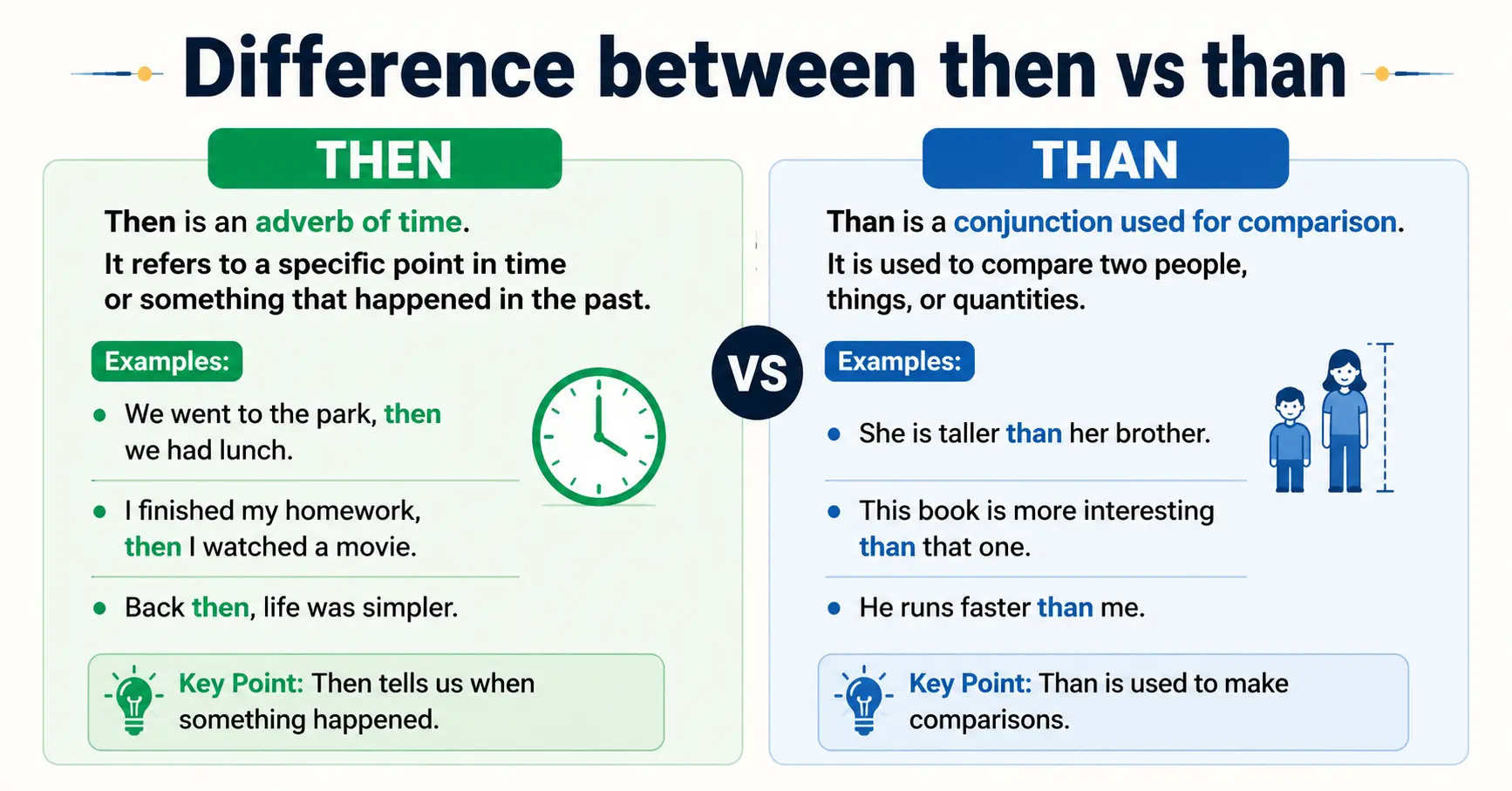
Difference between then vs than two words just one letter apart yet they trip up millions of writers every single day. These commonly confused words sound almost identical in casual speech, which is exactly why so many people mix them up. But here is the truth: once you understand what each word actually does, you will never confuse them again.
This guide gives you everything you need, including clear definitions, grammar roles, memory tricks, real-world examples, a quick-reference table, and the most common mistakes to avoid. Whether you are a student, blogger, or professional writer, mastering these confused words will help you write with greater clarity and confidence.
What you will learn in this article:
- Then its meaning, grammar roles, and every correct usage
- Than its meaning, grammar roles, and every correct usage
- A side-by-side comparison table for instant reference
- The most common mistakes writers make (and how to fix them)
- Memory tricks and quick tests you can use anywhere
- Answers to the most frequently asked questions
Why Then and Than Are So Commonly Confused

Understanding the difference between then and than is essential for clear and accurate writing. Although these commonly confused words look and sound alike, they perform entirely different functions in a sentence. One relates to time and sequence while the other is used to make comparisons.
Learning when to use each word correctly can improve your grammar strengthen your communication, and help you avoid one of the most frequent mistakes in English. Before exploring specific examples and rules, it is helpful to understand why so many writers mix these two words up in the first place.
Quick Snapshot: Then vs. Than at a Glance
Before diving deep, here is the single most important rule you need to memorize:
| Word | Core Meaning | Grammar Role | Quick Test |
| THEN | Time / sequence / consequence | Adverb, noun, adjective | Can you replace it with ‘at that time’ or ‘next’? |
| THAN | Comparison | Conjunction, preposition | Are you comparing two things? |
The one line rule: Then time Than comparison keep that distinction in mind and you will get it right every time.
Understanding Then Definition Grammar Roles and Examples
What Does Then Mean
Then is primarily an adverb that relates to time. It indicates when something happened, what comes next in a sequence, or what follows as a result or consequence of something. Because it deals with time and order, then answers the question When or What happened next.
Then as an Adverb (Most Common Use
Then works as an adverb in three distinct ways:
- To indicate a point in time: Back then, smartphones did not exist.
- To show sequence or order: Finish your homework, and then you can play outside.
- To express consequence or conclusion: If you are tired, then you should sleep.
Then as a Noun
Then can function as a noun meaning that time or that moment This usage is less common but completely correct.
Example: I have not seen her since then
Example: Until then we will have to wait
Then as an Adjective
Then can describe someone’s role or status at a previous point in time.
Example: The then-prime minister announced the policy change
Example: Her then-husband later became a famous author.
Then in If-Then Statements
Then is used with if to express a logical consequence this is one of its most important and widely used patterns.
Example: If it rains then we will cancel the picnic
Example: If the code compiles then the tests can begin
Full Example List: ‘Then’ in Sentences
| Sentence | Use of Then |
| We ate dinner and then watched a movie. | Sequence next’ |
| Back then, prices were much lower. | Past time reference |
| I will finish this report and then take a break. | Sequential order |
| If you study hard, then you will pass. | Consequence (if-then) |
| Since then, the company has grown rapidly. | Then as a noun |
| The then-CEO made a bold decision. | Then as an adjective |
| Right then and there, she made up her mind. | Idiom: at that exact moment |
| We cooked, cleaned, and then relaxed. | Listing events in order |
Understanding Than Definition Grammar Roles and Examples

What Does than Mean
Than is a word used to make comparisons whenever you are placing two people, things, amounts, or ideas side by side and pointing out a dience between them, you use than It introduces the second part of the comparison.
Than as a Conjunction (Most Common)
Than most commonly acts as a conjunction, connecting two clauses or elements being compared.
Example: She runs faster than he does.
Example: The new phone is more expensive than the old model.
Example: I would rather read a book than watch television.
Than as a Preposition
Than can also work as a preposition, followed directly by a noun or pronoun (rather than a full clause).
Example: She is taller than me (informal/spoken)
Example: He is older than her by three years.
Note on Pronoun Case After ‘Than’
This is a subtlety that competitors largely ignore when a pronoun follows than the case you choose changes the meaning of the sentence.
| Sentence | Meaning |
| She likes coffee more than I [do]. | She likes coffee more than I like coffee. |
| She likes coffee more than me. | She likes coffee more than she likes me. |
In formal writing complete the elliptical clause mentally to make sure you are using the right pronoun in casual speech, both forms are widely accepted.
Full Example List: Than in Sentences
| Sentence | Use of Than |
| My brother is taller than I am. | Physical comparison |
| This task is easier said than done. | Idiomatic expression |
| She earned more than he expected. | Quantity comparison |
| Other than coffee, she drinks nothing. | Meaning ‘except for’ |
| No sooner had we arrived than it started raining. | ‘No sooner…than’ structure |
| He would rather fail than cheat. | Expressing preference |
| The results were better than predicted. | Outcome comparison |
| There are more options than you think. | Quantity vs. expectation |
Side by Side Comparison Then vs Than
| Feature | THEN | THAN |
| Core meaning | Time / sequence / consequence | Comparison |
| Primary grammar role | Adverb | Conjunction |
| Secondary roles | Noun, adjective | Preposition |
| Pronunciation | Short e sound (THEN) | Short ‘a’ sound (THAN) |
| Answers the question | When / What next | Compared to what? |
| Common word partners | since, until, back, right, if…then | more, less, rather, other, better, worse |
| Can follow ‘if’? | Yes (if…then) | No |
| Used for comparisons? | No | Yes |
| Used for time? | Yes | No |
Most Common Mistakes Writers Make
Most errors fall into a small number of predictable patterns knowing these helps you self-correct quickly.
| Incorrect | Correct | Why |
| She is smarter then him. | She is smarter than him. | Comparison requires ‘than,’ not ‘then’ |
| We ate dinner, than we left. | We ate dinner, then we left. | Sequence requires ‘then,’ not ‘than’ |
| I would rather stay home then go out. | I would rather stay home than go out. | ‘Rather…than’ expresses preference |
| Other then that, everything is fine. | Other than that, everything is fine. | ‘Other than’ is the fixed expression |
| No sooner had I sat down then the phone rang. | No sooner had I sat down than the phone rang. | ‘No sooner…than’ is the fixed structure |
| Back than, things were different. | Back then, things were different. | Time reference requires ‘then’ |
| More then enough food was served. | More than enough food was served. | Quantity comparison requires ‘than’ |
Memory Tricks to Never Get It Wrong Again
These simple techniques work instantly and stick in your memory:
Trick 1: The Vowel Trick
Then contains the letter E, just like time and sequence. If you are writing about time, use then.
Than contains the letter A, just like compare and grade. If you are comparing, use than.
Trick 2: The Substitution Test
Replace the word with ‘at that time.’ If the sentence still makes sense, use then.
Example: ‘We ate and [at that time] went home.’ Yes, this works. Use then.
Example: ‘She is taller [at that time] me. No, this does not work. Use than.
Trick 3: Ask ‘Am I Comparing?’
If you are setting two things against each other, you need than. If no comparison is happening, you almost certainly need then.
Trick 4: The ‘Time’ Acronym
Then = Time Both words start with THE ‘Then’ has an E for events in chronological order. Than has an A because you use it when contrasting item A against item B.
Fixed Expressions and Idioms: Learn These Cold
Many frequently used phrases are locked to either then or than. Memorize these as complete units:
Always use THAN
| Fixed Expression | Example Sentence |
| More than | There were more than a hundred guests at the event. |
| Less than | The project took less than two weeks to complete. |
| Better than | Her second attempt was far better than the first. |
| Other than | Other than coffee, she does not drink hot beverages. |
| Rather than | He chose to apologize rather than argue. |
| No sooner…than | No sooner had we arrived than the music stopped. |
| Easier said than done | Sticking to a budget is easier said than done. |
| Better late than never | He apologized a week later — better late than never. |
| More dead than alive | After the hike, we were more dead than alive. |
Always use THEN:
| Fixed Expression | Example Sentence |
| Back then | Back then, people relied on printed maps. |
| Since then | She graduated in 2019, and since then has built a career in finance. |
| Until then | The meeting is next Friday — until then, keep working on the draft. |
| Right then and there | He decided right then and there to quit his job. |
| Every now and then | Every now and then, we revisit our goals. |
| And then some | She gave her full effort and then some. |
| Even then | Even then, the problem was not fully resolved. |
| If…then | If you finish early, then you can leave. |
Pronunciation Why This Pair Gets Confused
Then and than are pronounced very similarly in fast or casual speech many native speakers reduce both words to a schwa sound (like ‘thun’), which makes them nearly indistinguishable when spoken.
| Word | Standard Pronunciation | Common Reduced Form in Speech |
| Then | /ðɛn/ — short ‘e’ as in ‘pen’ | Often sounds like ‘thun’ |
| Than | /ðæn/ — short ‘a’ as in ‘pan’ | Often sounds like ‘thun’ |
Because the spoken forms blur together it is essential to train yourself to check these words carefully when writing the sound alone is not a reliable guide.
Formal Writing vs Informal Speech Does the Rule Change
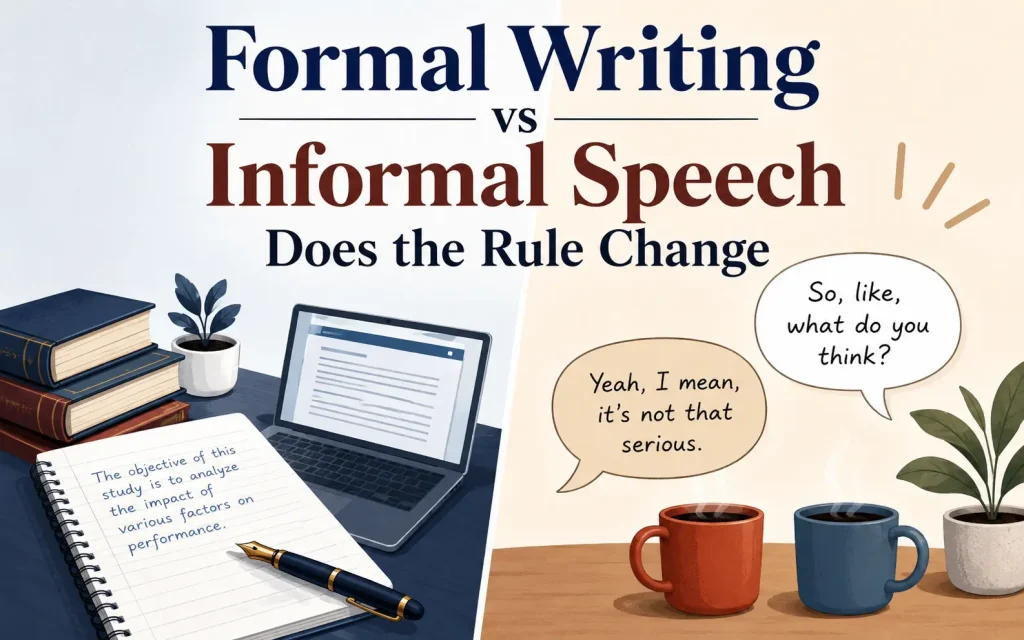
No The core rule does not change between formal and informal contexts. However, two nuances are worth knowing:
Pronoun case after ‘than
In formal writing, using ‘I,’ ‘she,’ or ‘he’ after ‘than’ is grammatically cleaner because it signals an implied verb. ‘She is faster than I [am].’ In casual speech, ‘She is faster than me’ is universally accepted and natural.
Contractions and shortening:
‘Then’ is sometimes omitted in very casual writing (‘We ate and went home’), but ‘than’ is rarely omitted because the comparison would become unclear without it. In academic or professional writing, always include both words.
Practice: Fill in the Blank
Test yourself fill in each blank with then or than. Answers appear below:
| # | Sentence |
| 1 | I finished my work, and I went for a walk. |
| 2 | She is far more experienced her colleague. |
| 3 | Back the city looked completely different. |
| 4 | He would rather fail give up his principles. |
| 5 | We will discuss the results, present the findings. |
| 6 | Other a mild headache, she felt fine. |
| 7 | If the deadline is missed we must notify the client. |
| 8 | No sooner had he sat down his phone rang. |
Answers:
- then sequence of events
- than comparing experience levels
- then past time reference
- than’ rather than’ expressing preference
- then sequential order of actions
- than other than’ meaning ‘except for’
- then if then’ expressing consequence
- than no sooner than’ is the fixed structure
FAQs
What is the main difference between then and than?
Then is used for time or sequence, while than is used for comparison between two things.
Can then and than be used in the same sentence?
Yes, but only when their meanings are correct. For example: “Finish your work then take a break than others who are still working” (context-based use in complex sentences).
Why do people confuse then and than?
People confuse them because they sound very similar in spoken English, but they have completely different grammar roles.
How can I remember the difference easily?
Remember: then = time (next, after that) and than = comparison (more, less, better).
Is using then instead of than a serious mistake?
It is a common grammar mistake, especially in informal writing, but in professional writing it can affect clarity and correctness.
Final Thought
Then and than are two of the most commonly confused words in the English language, but the rule separating them is clean and simple: use then for everything related to time and sequence, and use than for every comparison.
Once you internalize the vowel trick and the substitution test, choosing between these two words will become automatic. Practice with the sentences above, pay attention to fixed expressions and you will find that what once felt confusing becomes second nature.
