
The difference between affect vs effect is one of the most common grammar questions in English. These two words sound similar, look similar, and often appear in the same type of sentence. That is why many writers, students, bloggers, and even professionals mix them up.
The simple rule is this:
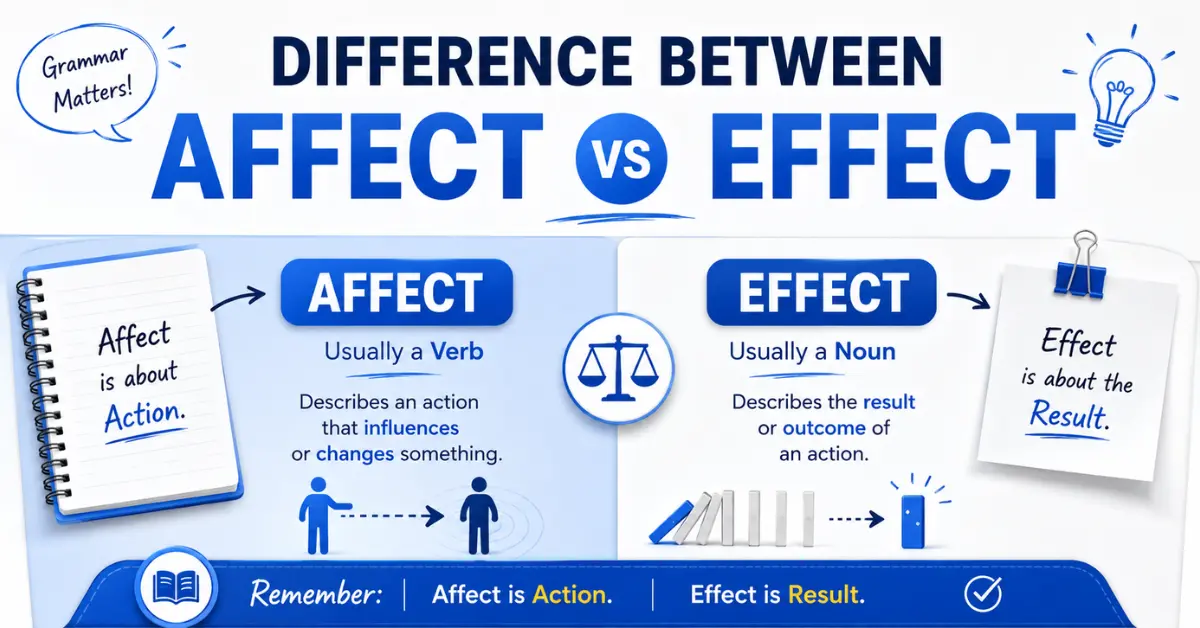
Affect is usually a verb. It means to influence or change something.
Effect is usually a noun. It means the result or outcome of a change.
Example:
The cold weather can affect your health.
The effect of cold weather can be a sore throat or fever.
In the first sentence, affect shows an action. In the second sentence, effect shows the result.
Quick Answer: Affect vs Effect
| Word | Usually Used As | Meaning | Simple Example |
|---|---|---|---|
| Affect | Verb | To influence or change something | Stress can affect your sleep. |
| Effect | Noun | A result or outcome | Poor sleep has a bad effect on health. |
If you only remember one thing, remember this:
Affect = action
Effect = end result
What Does Affect Mean?
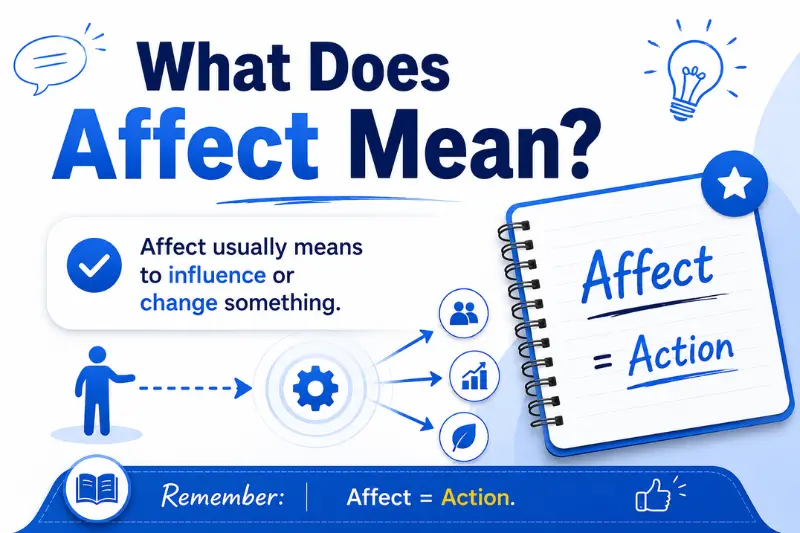
Affect usually means to influence, change, or make a difference to something. It is most often used as a verb.
You use affect when one thing has an impact on another thing.
Examples of Affect in Sentences
- Heavy rain can affect road safety.
- Lack of sleep can affect your memory.
- Social media can affect how people think.
- Bad weather may affect flight schedules.
- A teacher’s support can affect a student’s confidence.
In all these examples, something is causing a change. That is why affect is the correct word.
What Does Effect Mean?
Effect usually means the result, outcome, or consequence of something. It is most often used as a noun.
You use effect when you are talking about what happened after an action or event.
Examples of Effect in Sentences
- The medicine had a positive effect.
- The new law had a strong effect on businesses.
- The effect of exercise is better health.
- The storm had a serious effect on traffic.
- Too much screen time can have a negative effect on sleep.
In these examples, effect means the result of something.
Affect vs Effect in One Simple Sentence
Here is the easiest way to understand both words together:
The new rule affected students, and its effect was better attendance.
In this sentence:
- Affected = changed or influenced students
- Effect = the result of the new rule
Easy Trick to Remember Affect and Effect
A simple memory trick is:
A = Action = Affect
E = End Result = Effect
So ask yourself:
Is the word showing an action?
Use affect.
Is the word showing a result?
Use effect.
Example
Incorrect:
The weather had a strong affect on the game.
Correct:
The weather had a strong effect on the game.
Why? Because the sentence is talking about the result of the weather, not the action.
Affect vs Effect: Side-by-Side Comparison
| Question | Use Affect | Use Effect |
|---|---|---|
| Is it an action? | Yes | No |
| Is it a result? | No | Yes |
| Is it usually a verb? | Yes | No |
| Is it usually a noun? | No | Yes |
| Common meaning | To influence | A result |
| Example | Noise can affect focus. | Noise has an effect on focus. |
Common Phrases With Effect
Some common English phrases almost always use effect, not affect.
Use effect in these phrases:
- side effect
- take effect
- in effect
- cause and effect
- lasting effect
- special effects
- negative effect
- positive effect
- ripple effect
- long-term effect
Examples
- The medicine has a few side effects.
- The new policy will take effect tomorrow.
- The rule is still in effect.
- The movie had amazing special effects.
- Pollution has a long-term effect on health.
Common Phrases With Affect
Use affect when the sentence shows influence, change, or impact.
Common phrases include:
- affect your health
- affect your mood
- affect your decision
- affect the result
- affect performance
- affect growth
- affect behavior
- affect the environment
Examples
- Sleep can affect your mood.
- Price changes can affect customer decisions.
- Climate change can affect the environment.
- Practice can affect your performance.
- Stress can affect your behavior.
Affect vs Effect: Common Mistakes
Many people use the wrong word because both words sound almost the same. Here are some common mistakes and the correct versions.
Mistake 1: Side Affect
Incorrect:
This medicine has a side affect.
Correct:
This medicine has a side effect.
Why? A side effect is a result of medicine.
Mistake 2: Take Affect
Incorrect:
The new rule will take affect next week.
Correct:
The new rule will take effect next week.
Why? “Take effect” is the correct phrase.
Mistake 3: Affect on
Incorrect:
The speech had a strong affect on the audience.
Correct:
The speech had a strong effect on the audience.
Why? The sentence is talking about the result of the speech.
Mistake 4: Effect Your Mood
Incorrect:
Music can effect your mood.
Correct:
Music can affect your mood.
Why? Music is influencing your mood, so use affect.
Affect vs Effect in Real-Life Examples
Health Example
Correct:
Lack of water can affect your body.
Correct:
The effect of dehydration can be tiredness and headache.
Education Example
Correct:
A good teacher can affect a student’s learning.
Correct:
The effect of good teaching is better understanding.
Weather Example
Correct:
Rain can affect outdoor events.
Correct:
The effect of rain was a delayed match.
Business Example
Correct:
High prices can affect customer demand.
Correct:
The effect of high prices was lower sales.
Technology Example
Correct:
Artificial intelligence can affect the job market.
Correct:
One effect of AI is faster automation.
Affect vs Effect: Grammar Rule
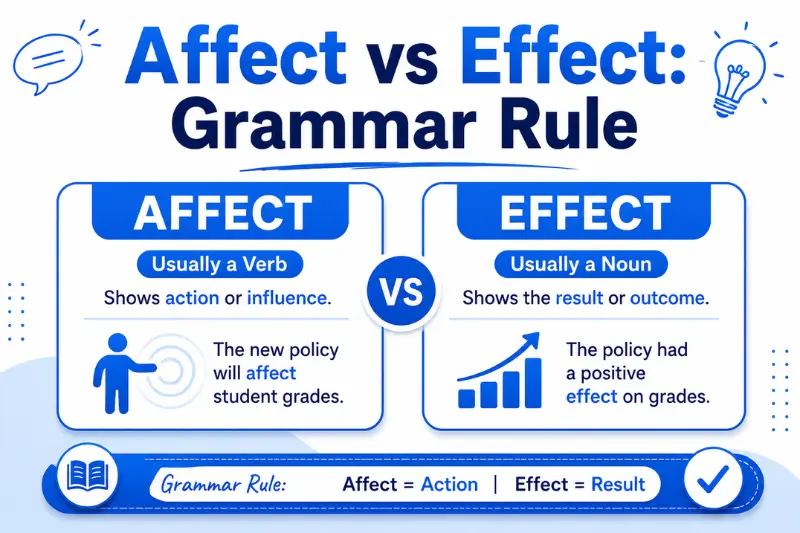
In most sentences:
Affect works as a verb.
Effect works as a noun.
A verb shows action. A noun names a thing, idea, result, or outcome.
Affect as a Verb
- The news affected him deeply.
- The change will affect everyone.
- Your attitude can affect your success.
Effect as a Noun
- The news had a deep effect on him.
- The change had an effect on everyone.
- Your attitude can have an effect on your success.
Rare Exceptions You Should Know
The basic rule works most of the time, but there are a few exceptions.
Effect as a Verb
Sometimes effect can be used as a verb. When used as a verb, effect means to bring about, create, or make something happen.
This usage is more formal.
Example
The new leader wants to effect change in the company.
This means the leader wants to bring change into existence.
Affect Change vs Effect Change
This is a common confusing phrase.
| Phrase | Meaning |
|---|---|
| Affect change | To influence change |
| Effect change | To bring change about |
Examples:
The speech affected change in public opinion.
This means the speech influenced the change.
The new policy effected change in the system.
This means the policy created the change.
In everyday writing, most people mean effect change when they want to say “bring change.”
Affect as a Noun
Sometimes affect can be a noun, but this is mostly used in psychology. As a noun, affect means a visible emotional expression or response.
Example
The patient showed a flat affect.
This means the patient showed little or no visible emotion.
This use is uncommon in everyday English. Most of the time, you will use affect as a verb.
How to Choose the Correct Word
Before choosing affect or effect, ask these questions:
1. Am I talking about an action?
If yes, use affect.
Example:
Cold weather can affect plants.
2. Am I talking about a result?
If yes, use effect.
Example:
Cold weather has a harmful effect on plants.
3. Can I replace the word with “influence”?
If yes, use affect.
Example:
Stress can affect your health.
Stress can influence your health.
4. Can I replace the word with “result”?
If yes, use effect.
Example:
The effect was surprising.
The result was surprising.
Affect vs Effect Practice Examples
Choose the correct word in each sentence.
1. The loud noise can affect/effect your focus.
Correct answer: affect
The loud noise is influencing your focus.
2. The new schedule had a positive affect/effect.
Correct answer: effect
The sentence is talking about the result.
3. Exercise can affect/effect your energy levels.
Correct answer: affect
Exercise influences your energy.
4. The effect/affect of the storm was serious damage.
Correct answer: effect
Damage is the result of the storm.
5. The law will take affect/effect next month.
Correct answer: effect
The correct phrase is take effect.
Affect vs Effect for Students and Writers
If you are writing an essay, blog post, email, report, or academic paper, using the correct word makes your writing clearer and more professional.
Use this simple pattern:
Something affects something else.
Something has an effect on something else.
Examples:
- Technology affects communication.
- Technology has an effect on communication.
- Diet affects health.
- Diet has an effect on health.
- Education affects career opportunities.
- Education has an effect on career opportunities.
Difference Between Affect and Effect in Simple Words
The difference between affect and effect is simple when you focus on action and result.
Affect means something is changing or influencing something else.
Effect means the result of that change.
Example:
The teacher’s feedback affected my confidence.
This means the feedback changed my confidence.
The effect of the feedback was better performance.
This means better performance was the result.
FAQs About Affect vs Effect
What is the difference between affect vs effect?
The difference is that affect usually means to influence something, while effect usually means the result of something. Affect is usually a verb, and effect is usually a noun.
Is affect a verb or noun?
Affect is usually a verb. It means to influence, change, or make a difference.
Example:
The weather can affect your plans.
Is effect a noun or verb?
Effect is usually a noun. It means a result or outcome.
Example:
The weather had an effect on our plans.
Is it “affect change” or “effect change”?
Both can be correct, but they mean different things. Affect change means to influence change. Effect change means to bring change about or make it happen.
Is it “side affect” or “side effect”?
The correct phrase is side effect.
Example:
This medicine may cause side effects.
Is it “take affect” or “take effect”?
The correct phrase is take effect.
Example:
The new rule will take effect tomorrow.
Can affect and effect be used in the same sentence?
Yes.
Example:
The new policy affected employees, and its effect was higher productivity.
What is the easiest way to remember affect and effect?
Remember this:
A = Action = Affect
E = End Result = Effect
This simple trick works in most sentences.
Final Summary
The main difference between affect vs effect is that affect is usually a verb, while effect is usually a noun.
Use affect when you mean to influence or change something.
Use effect when you mean a result, outcome, or consequence.
Remember this simple trick:
Affect = Action
Effect = End result
Most of the time, this rule will help you choose the correct word.
