

The difference between immigrate and emigrate depends on the direction of movement. Immigrate means to come into a new country to live there. Emigrate means to leave your country to live somewhere else. Both words describe a person moving from one country to another, but they focus on different sides of the journey.
For example, if a person leaves India and moves to Canada, that person emigrates from India and immigrates to Canada. The action is the same, but the point of view changes. India is the country of departure, so we use emigrate. Canada is the destination country, so we use immigrate.
This is why these two words often confuse English learners, students, writers, and even native speakers. The easiest way to understand them is to focus on one question: are you talking about the country someone is leaving, or the country someone is entering?
Quick Answer
- Use immigrate when the sentence focuses on the country someone moves to.
- Use emigrate when the sentence focuses on the country someone moves from.
A simple rule is:
- Immigrate to a country
- Emigrate from a country
- Immigrate means move in
- Emigrate means exit
Example:
He emigrated from Pakistan and immigrated to Canada.
What Does Immigrate Mean?
Immigrate means to enter a foreign country and live there permanently or for a long time. This word focuses on the destination, which is the new country where a person arrives.
People usually immigrate for reasons such as work, education, marriage, family, safety, or better living conditions. The word is commonly used in news reports, government forms, legal discussions, school lessons, and everyday English.
For example, when you say, “She immigrated to Australia,” you are focusing on Australia as the country she entered. You are not mainly talking about the country she left. The important idea is that she came into Australia to live there.
Correct examples:
- My family immigrated to the United States when I was ten.
- She immigrated to Canada after getting a job offer.
- Many people immigrate to Germany for work and study.
- His parents immigrated to New Zealand before he was born.
The most common pattern is immigrate to + country.
Example:
They immigrated to France.
You can also mention the original country, but the focus still stays on the destination.
Example:
They immigrated to France from Morocco.
What Does Emigrate Mean?
Emigrate means to leave your country or the place where you live in order to settle in another country. This word focuses on departure, which means the country a person leaves.
When you say, “He emigrated from Spain,” you are focusing on Spain as the country he left. The sentence does not need to mention the destination, although you can include it if you want to give the full picture.
People may emigrate because of job opportunities, education, family reasons, political problems, war, economic hardship, or personal choice. The word is especially useful when the main idea is about people leaving a country.
Correct examples:
- Her grandparents emigrated from Italy in the 1960s.
- He emigrated from India to Canada.
- Many families emigrated from Ireland during difficult times.
- She plans to emigrate from her home country next year.
The most common pattern is emigrate from + country.
Example:
They emigrated from Spain.
You can also include the destination.
Example:
They emigrated from Spain to Argentina.
Main Difference Between Immigrate and Emigrate
The main difference is point of view. If you are looking at the movement from the destination country, use immigrate. If you are looking at the movement from the country of departure, use emigrate.
Think about this sentence:
Ali left Pakistan and moved to Canada.
- From Pakistan’s point of view, Ali emigrated.
- From Canada’s point of view, Ali immigrated.
So, the same person can be both an emigrant and an immigrant. He is an emigrant from Pakistan because he left Pakistan. He is an immigrant in Canada because he entered Canada to live there.
Immigrate vs Emigrate Comparison
| Word | Meaning | Focus | Common Preposition | Example |
|---|---|---|---|---|
| Immigrate | To enter a new country to live there | Arrival | To | She immigrated to Canada. |
| Emigrate | To leave a country to live elsewhere | Departure | From | She emigrated from India. |
| Migrate | To move from one place to another | Movement | To or from | Birds migrate south in winter. |
Easy Memory Trick
The easiest way to remember the difference is by using the first letter.
- Immigrate starts with I, and I can remind you of in. So, immigrate means to move in to a country.
- Emigrate starts with E, and E can remind you of exit. So, emigrate means to exit a country.
Remember it like this:
- I = In = Immigrate
- E = Exit = Emigrate
This trick works in most sentences.
How to Use Immigrate and Emigrate Correctly
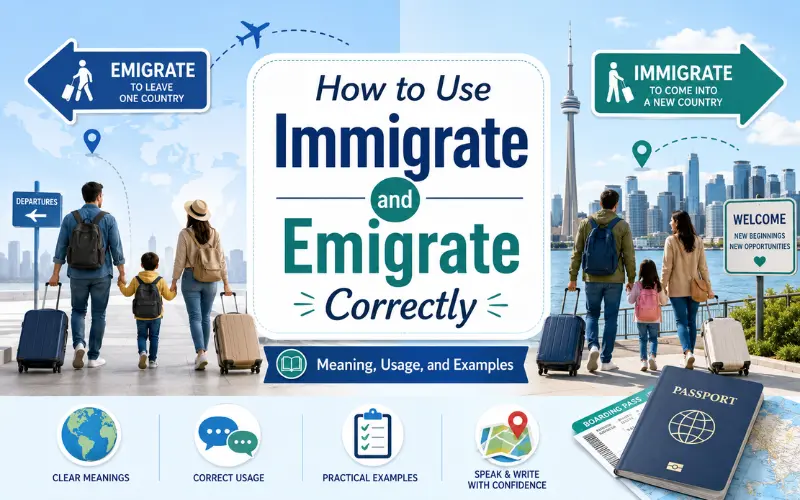
The words become much easier when you learn their common sentence patterns.
Use these patterns:
- Immigrate to + new country
- Immigrate to + new country + from + old country
- Emigrate from + old country
- Emigrate from + old country + to + new country
Examples:
- She immigrated to Canada.
- She immigrated to Canada from India.
- She emigrated from India.
- She emigrated from India to Canada.
All four sentences can be correct. The difference is what you want to emphasize. If you want to emphasize Canada, use immigrate. If you want to emphasize India, use emigrate.
Immigrate and Emigrate in the Same Sentence
You can use both words in the same sentence when you want to show the complete journey.
Example:
- She emigrated from China and immigrated to Australia.
This sentence is correct because it explains both sides of the move. China is the country she left, so she emigrated from China. Australia is the country she entered, so she immigrated to Australia.
More examples:
- My uncle emigrated from Mexico and immigrated to the United States.
- They emigrated from Turkey and immigrated to Germany.
- Her parents emigrated from Korea and immigrated to Canada.
This structure is helpful when you want to make the meaning very clear.
What Does Migrate Mean?
Migrate is a broader word. It means to move from one place to another, but it does not always mean moving permanently to another country. It can describe people, animals, birds, workers, or groups.
For example, birds migrate during different seasons. Workers may migrate from rural areas to cities. Families may migrate within the same country for better opportunities.
Examples:
- Birds migrate south in winter.
- Many workers migrate to cities for jobs.
- Some families migrate from rural areas to urban areas.
- Monarch butterflies migrate long distances every year.
The main difference is that migrate focuses on movement itself. Immigrate and emigrate focus on international movement for living in another country.
Immigrant, Emigrant, Immigration, and Emigration
These related words are also important because they often appear in the same topic.
An immigrant is a person who enters a new country to live there.
- Example:
She is an immigrant in Canada. - An emigrant is a person who leaves a country to live somewhere else.
- Example:
She is an emigrant from India. - Immigration is the process of entering a country to live there.
- Example:
Immigration to Canada has increased. - Emigration is the process of leaving a country to live elsewhere.
- Example:
Emigration from the country increased after the economic crisis.
The same person can be an immigrant and an emigrant at the same time. It depends on which country you are talking about.
Common Mistakes to Avoid
Many people make mistakes with these words because the meanings are connected. The mistake usually happens when someone uses the wrong preposition or focuses on the wrong country.
Common mistakes include:
- Saying immigrated from when the sentence only focuses on leaving
- Saying emigrated to when the sentence only focuses on arriving
- Thinking immigrate and emigrate are different spellings of the same word
- Using immigrate or emigrate for short trips or vacations
- Using immigrate for animals when migrate is usually better
- Incorrect:
He immigrated from India in 2018. - Better:
He emigrated from India in 2018. - Also correct:
He immigrated to Canada from India in 2018. - Incorrect:
She emigrated to Australia. - Better:
She immigrated to Australia. - Also correct:
She emigrated from England to Australia.
Are Immigrate and Emigrate Used for Short Trips?
No, immigrate and emigrate are not normally used for short trips, vacations, tourism, or business visits. These words usually mean moving to another country to live there for a long time or permanently.
For example, you should not say:
- I immigrated to France for a two-week vacation.
A better sentence is:
- I traveled to France for a two-week vacation.
Use immigrate or emigrate only when someone is moving to live in another country, not just visiting.
Are Immigrate and Emigrate Only Used for Countries?
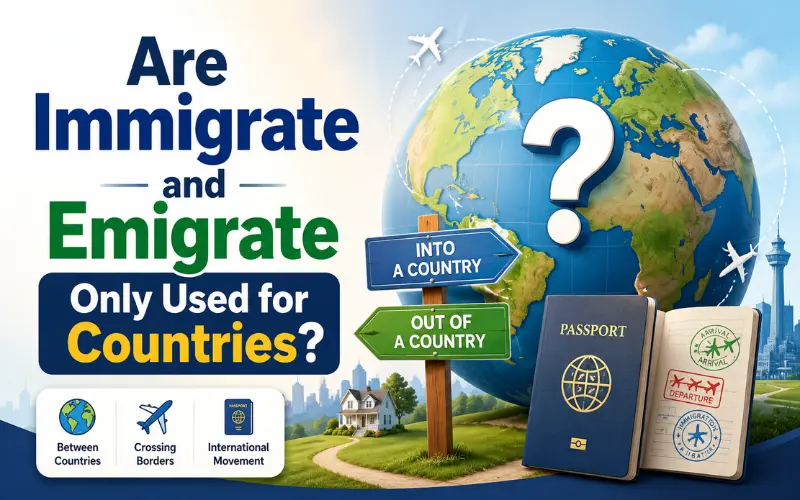
Most of the time, yes. Immigrate and emigrate are usually used when people move from one country to another. They can sometimes be used for regions in historical or formal contexts, but in everyday English, they mainly refer to countries.
For movement within the same country, use words like move, relocate, or migrate.
Example:
- He moved from Lahore to Karachi.
This is better than saying:
- He immigrated from Lahore to Karachi.
More Natural Example Sentences
Here are more examples of how native speakers use these words:
- My parents immigrated to Canada before I was born.
- Many families emigrated from Europe during the war.
- She immigrated to the United States for work.
- They emigrated from their homeland because of political problems.
- He immigrated to Germany after receiving a job offer.
- Thousands of people emigrated from the region during the crisis.
- My cousin wants to immigrate to Australia.
- Her grandparents emigrated from Italy many years ago.
FAQs
What is the difference between immigrate and emigrate?
The difference between immigrate and emigrate is direction. Immigrate means to come into a new country to live there, while emigrate means to leave your country to live somewhere else. For example, if someone leaves India and moves to Canada, they emigrated from India and immigrated to Canada.
Is it immigrate to or immigrate from?
The most natural phrase is immigrate to because immigrate focuses on the country someone enters. For example, you should say, “She immigrated to Canada.” You can also say, “She immigrated to Canada from India” if you want to mention both countries.
Is it emigrate to or emigrate from?
The most natural phrase is emigrate from because emigrate focuses on the country someone leaves. For example, you should say, “He emigrated from Germany.” You can also say, “He emigrated from Germany to the United States” if you want to include the destination.
Can one person be both an immigrant and an emigrant?
Yes, one person can be both an immigrant and an emigrant. It depends on the point of view. A person who leaves Pakistan and moves to Canada is an emigrant from Pakistan because they left Pakistan, and an immigrant in Canada because they entered Canada to live there.
What is the difference between migrate and immigrate?
Migrate is a general word that means to move from one place to another. It can describe people, birds, animals, or workers. Immigrate is more specific because it means to enter another country to live there for a long time or permanently.
Are immigrate and emigrate used for vacations?
No, immigrate and emigrate are not normally used for vacations, short trips, or business visits. These words are used when someone moves to another country to live there. For a short trip, it is better to use words like “travel,” “visit,” or “go to.”
Conclusion
The difference between immigrate and emigrate is easy to understand when you focus on direction. Immigrate means to enter a new country to live there, while emigrate means to leave a country to live somewhere else. Use immigrate to when focusing on the destination, and use emigrate from when focusing on the country of departure. A simple way to remember the rule is this: immigrate means move in, and emigrate means exit.
You May Also Like It:
Difference Between Fewer vs Less
Difference Between Time Flies vs Time Flys
