
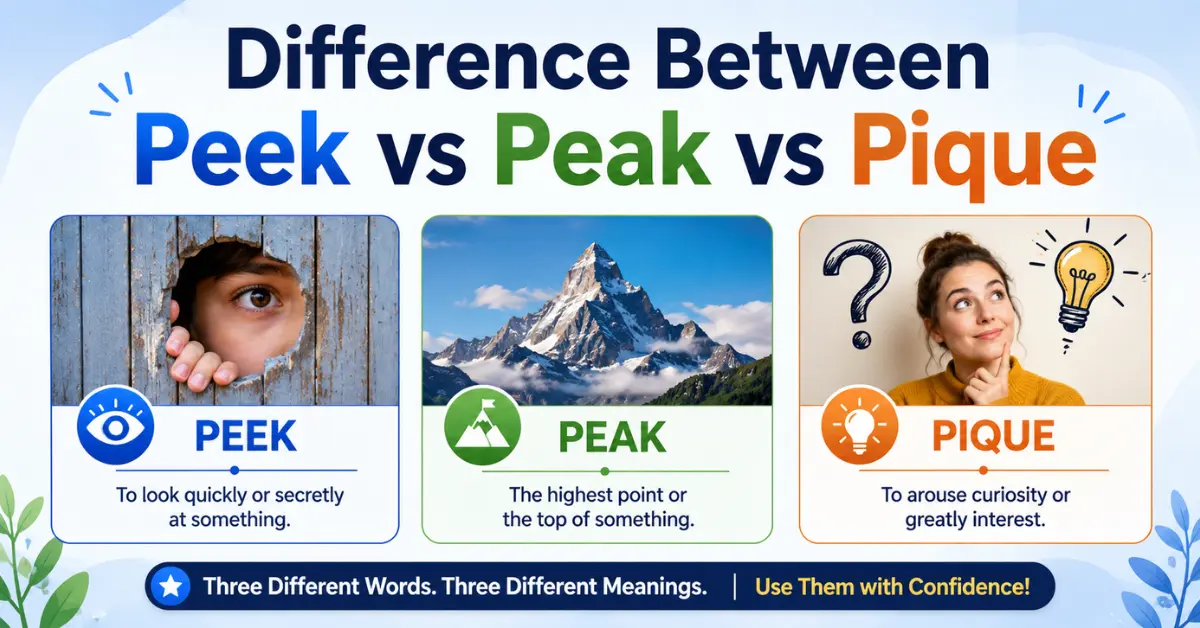
The difference between peek vs peak vs pique can confuse many writers because these three words sound exactly the same. However, they have completely different meanings. Peek is connected to looking, peak refers to the highest point or level, and pique means to arouse interest, curiosity, or sometimes irritation.
These words are called homophones. Homophones are words that have the same pronunciation but different spellings and meanings. That is why someone may write “sneak peak” instead of “sneak peek” or “peaked my interest” instead of “piqued my interest.” The mistake is common, but once you understand the meaning of each word, it becomes easy to choose the correct one.
In simple words, use peek when someone looks at something, use peak when something reaches the highest point, and use pique when something creates interest or curiosity. This article explains each word clearly with examples, common phrases, grammar notes, and easy tricks to help you remember the difference.
Quick Meaning of Peek, Peak, and Pique
Before going into detail, here is the easiest way to understand the three words.
Peek means to take a quick look. For example, a child may peek at a birthday gift before the party. The word is always related to seeing, looking, or glancing.
Peak means the highest point of something. It can be the top of a mountain, the highest level of success, the busiest time of day, or the strongest point in performance.
Pique means to stimulate interest, curiosity, attention, or sometimes irritation. When something makes you curious, it piques your curiosity. When something makes you interested, it piques your interest.
What Does Peek Mean?
Peek means to look quickly, secretly, or for a short time. You usually use this word when someone looks at something without wanting to be noticed, or when they only take a brief look.
For example, if a child opens the door slightly to see what is happening inside a room, the child is peeking. If someone looks at the answer sheet before the test begins, they are also peeking. In both cases, the word is connected to looking.
Peek can be used as both a noun and a verb. As a verb, it means the action of looking. As a noun, it means the quick look itself.
For example:
- She peeked through the window.
- I took a peek inside the box.
- Do not peek at the answers.
- The cat peeked out from behind the sofa.
The phrase “take a peek” is very common in everyday English. It means to take a quick look at something. You may say, “Take a peek at this photo,” or “I had a quick peek at the new design.”
Common Uses of Peek
The word peek appears in many natural English phrases. One of the most common phrases is “sneak peek.” A sneak peek means an early or secret look at something before it is officially shown to everyone.
For example, a movie studio may release a sneak peek of a new film. A company may give customers a sneak peek of a product before launch. In both examples, the phrase means an early look, so peek is the correct spelling.
Another common phrase is “peek through.” This means to look through a small space, such as a window, curtain, doorway, or hole. For example, “She peeked through the curtains to see who was outside.”
You may also see “peek out.” This means something or someone appears slightly from behind or under something. For example, “A small flower peeked out from the snow.”
What Does Peak Mean?
Peak means the highest point, level, or stage of something. It can describe a real physical height, such as the top of a mountain, or it can describe a figurative high point, such as the best moment in a career or the busiest time of day.
When you say “the peak of the mountain,” you mean the top of the mountain. When you say “the peak of his career,” you mean the most successful or important point in his career. When you say “peak hours,” you mean the busiest hours.
Peak can work as a noun, verb, or adjective. This makes it more flexible than peek and pique.
As a noun, peak means the highest point. For example, “The climbers reached the peak before sunset.” Here, the peak is the top of the mountain.
As a verb, peak means to reach the highest level. For example, “Sales peaked in December.” This means sales reached their highest point in December.
As an adjective, peak means highest, maximum, or busiest. For example, “Avoid driving during peak traffic hours.” This means the traffic is at its busiest.
Common Uses of Peak
The word peak is often used in business, sports, travel, weather, education, and everyday conversation. In business, people talk about peak sales, peak demand, and peak season. In sports, people talk about peak fitness or peak performance. In travel, people talk about peak hours and peak tourist season.
For example, when a store says prices are higher during peak season, it means prices are higher during the busiest or most popular time of the year. When an athlete is in peak condition, it means the athlete is performing at the highest possible level.
You may also hear the phrase “at its peak.” This means something is at its strongest, highest, or most successful point. For example, “The festival was at its peak when the fireworks began.”
What Does Pique Mean?
Pique is the most unusual-looking word of the three. It sounds like peek and peak, but its spelling is very different. The word pique usually means to arouse, excite, or stimulate interest, curiosity, or attention.
The most common phrases are “piqued my interest” and “piqued my curiosity.” These phrases mean something made you interested or curious.
For example, if you see a mysterious book title and suddenly want to read the book, the title has piqued your interest. If you hear a strange sound and want to know where it came from, the sound has piqued your curiosity.
Examples:
- The unusual headline piqued my interest.
- Her story piqued my curiosity.
- The strange symbol piqued his attention.
- The smell of fresh bread piqued my appetite.
In modern English, pique is most often used with words like interest, curiosity, attention, imagination, and appetite.
Pique Can Also Mean Irritation
Although many people know pique because of the phrase “piqued my interest,” the word can also mean irritation, annoyance, or wounded pride. This use is more formal and less common, but it still appears in English.
For example, the phrase “in a fit of pique” means someone does something because they feel offended, annoyed, or insulted. If a person leaves a meeting angrily after someone criticizes their work, you could say they left in a fit of pique.
Examples:
- She left the room in a fit of pique.
- His rude comment piqued her.
- He acted out of pique after being ignored.
This meaning is useful to know, but for most everyday writing, you will probably use pique to talk about interest or curiosity.
Piqued My Interest or Peaked My Interest?
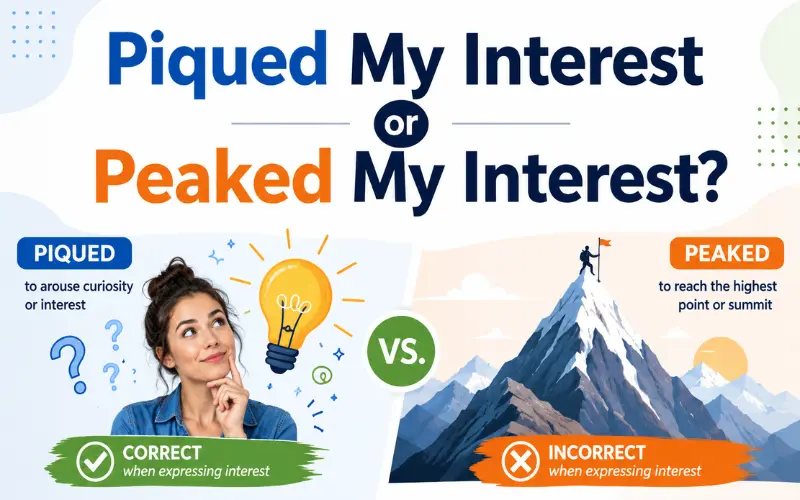
The correct phrase is “piqued my interest.”
This is one of the most common mistakes with these three words. Many people write “peaked my interest” because they know the word peak and assume it means interest has gone up. However, that is not correct.
Peak means the highest point. Pique means to arouse or stimulate. So when something makes you interested, it piques your interest.
Correct:
- The article piqued my interest.
- The documentary piqued my curiosity.
- The question piqued her attention.
Incorrect:
- The article peaked my interest.
- The documentary peeked my curiosity.
- The question peaked her attention.
The easiest way to remember this is simple: interest does not “climb a mountain,” so it does not peak. Interest gets sparked, so it is piqued.
Sneak Peek or Sneak Peak?
The correct phrase is “sneak peek.”
A sneak peek is a quick or early look at something. Since the meaning is related to looking, the correct word is peek.
Correct:
- We got a sneak peek of the new movie.
- The brand shared a sneak peek of its upcoming product.
- Fans enjoyed a sneak peek of the next episode.
Incorrect:
- We got a sneak peak of the new movie.
- The brand shared a sneak pique of its upcoming product.
This mistake is common because peak is a more familiar word to many people. But if the phrase means an early look, always use peek.
Peak Performance or Peek Performance?
The correct phrase is “peak performance.”
This phrase means the best or highest level of performance. Since it refers to the highest level, peak is the correct word.
Correct:
- The athlete trained hard to reach peak performance.
- The machine is working at peak efficiency.
- She was at her peak during the final round.
Incorrect:
- The athlete trained hard to reach peek performance.
- The machine is working at pique efficiency.
If the sentence talks about the highest level, maximum ability, or best condition, use peak.
How to Remember the Difference
A simple memory trick can help you choose the correct spelling every time.
Peek has two “e” letters, and you can imagine those two letters as two eyes. Since eyes are used for looking, peek means to look.
Peak has the letter “a,” and the shape of a capital “A” can remind you of a mountain. Since a mountain has a peak, peak means the highest point.
Pique looks unique, and it often means to spark curiosity or interest. When something catches your attention, it piques your interest.
So remember:
- Peek is for looking.
- Peak is for the highest point.
- Pique is for curiosity, interest, or irritation.
Peek, Peak, and Pique in Real Writing
These words often appear in different types of writing. In casual writing, you may use peek when talking about surprises, gifts, rooms, photos, or messages. For example, “I took a peek at the message before replying.”
In business writing, peak is very common because people often talk about sales, traffic, demand, productivity, and performance. For example, “Website traffic peaked after the campaign launched.”
In formal or creative writing, pique is useful when you want to describe curiosity, interest, or emotional reaction. For example, “The old letter piqued her curiosity and led her to search for answers.”
The key is to think about the meaning of the sentence. If the sentence is about looking, choose peek. If it is about the highest point, choose peak. If it is about interest or curiosity, choose pique.
Examples of Peek, Peak, and Pique in One Sentence
Using all three words in one sentence can make the difference easier to understand.
Example:
- I took a peek at the mountain peak, and the beautiful view piqued my interest in hiking.
In this sentence, peek means a quick look, peak means the top of the mountain, and piqued means created interest.
Here is another example:
- The sneak peek of the travel documentary showed a snowy peak, which piqued my curiosity about mountain climbing.
Again, each word has a clear role. Sneak peek means early look, peak means mountain top, and piqued means sparked curiosity.
Common Mistakes to Avoid
Some mistakes happen again and again because these words sound the same. The most important one is “peaked my interest.” This is wrong because interest is not reaching a highest point. The correct phrase is “piqued my interest.”
Another common mistake is “sneak peak.” This is also wrong because a sneak peek is an early look, not a high point. The correct phrase is “sneak peek.”
Writers also sometimes confuse peak season and peek season. The correct phrase is “peak season” because it means the busiest or most popular time.
A sentence like “He peaked through the window” is also incorrect. If someone is looking through the window, the correct word is peeked.
Correct versions:
- The headline piqued my interest.
- We watched a sneak peek of the film.
- Prices rise during peak season.
- He peeked through the window.
- Sales peaked in summer.
Mini Grammar Guide
Use peek when the sentence answers the question, “Did someone look?” If yes, peek is probably correct. For example, “She peeked into the room.”
Use peak when the sentence answers the question, “Is this the highest point or maximum level?” If yes, peak is correct. For example, “Demand reached its peak.”
Use pique when the sentence answers the question, “Did something create interest, curiosity, or irritation?” If yes, pique is correct. For example, “The mystery piqued my curiosity.”
This small grammar test works well because it focuses on meaning instead of sound.
More Natural Example Sentences

Here are some simple examples that show how native speakers use these words in daily writing.
Peek examples:
- I took a quick peek at the report before the meeting.
- The child peeked from behind the door.
- She tried not to peek at the surprise.
- A little sunlight peeked through the curtains.
Peak examples:
- The mountain peak was hidden by clouds.
- His confidence was at its peak after the win.
- Traffic peaks around 6 p.m.
- The company reached peak sales in December.
Pique examples:
- The question piqued my curiosity.
- The unusual design piqued her interest.
- His rude reply piqued her.
- The mystery piqued everyone’s attention.
Short Story Using Peek, Peak, and Pique
Maya loved reading mystery novels, but one book in the library caught her attention more than the others. Its dark cover and strange title immediately piqued her curiosity. She opened the book and took a quick peek at the first page.
The story began with a climber standing near the peak of a mountain, searching for a hidden message. Maya only planned to read one page, but her interest grew quickly. By the time she reached the second chapter, her excitement was at its peak.
Later that night, she told her friend that a single peek at the book had piqued her interest so much that she could not put it down.
This story shows how the three words work together naturally. Peek is about looking, peak is about the highest point, and pique is about creating interest.
FAQs
What is the difference between peek, peak, and pique?
Peek means to look quickly or secretly. Peak means the highest point or level. Pique means to arouse interest, curiosity, attention, or irritation.
Is it piqued my interest or peaked my interest?
The correct phrase is “piqued my interest.” It means something made you interested. “Peaked my interest” is a common spelling mistake.
Is it sneak peek or sneak peak?
The correct phrase is “sneak peek.” A sneak peek means an early or quick look at something.
What does peek mean?
Peek means to look quickly, secretly, or briefly. For example, “She peeked through the window.”
What does peak mean?
Peak means the highest point or level. It can refer to a mountain, performance, traffic, sales, demand, or success.
What does pique mean?
Pique usually means to make someone interested or curious. It can also mean to irritate or offend someone.
Can pique mean anger?
Yes. Pique can mean irritation or wounded pride, especially in the phrase “in a fit of pique.”
How can I remember peek, peak, and pique?
Remember that peek has two “e” letters like two eyes, peak has an “a” like a mountain shape, and pique means to spark curiosity or interest.
Conclusion
The difference between peek vs peak vs pique becomes clear when you focus on meaning. Peek means to look quickly or secretly. Peak means the highest point, strongest level, or busiest time. Pique means to arouse interest, curiosity, attention, or sometimes irritation.
The easiest way to avoid mistakes is to connect each word with a simple idea. Peek is for eyes and looking. Peak is for mountains and high points. Pique is for curiosity and interest.
So the next time you write sneak peek, peak performance, or piqued my interest, you will know exactly which word to use and why.
You May Also Like It:
Difference Between Immigrate and Emigrate
Difference Between Historic vs Historical
Difference Between Farther vs Further
