
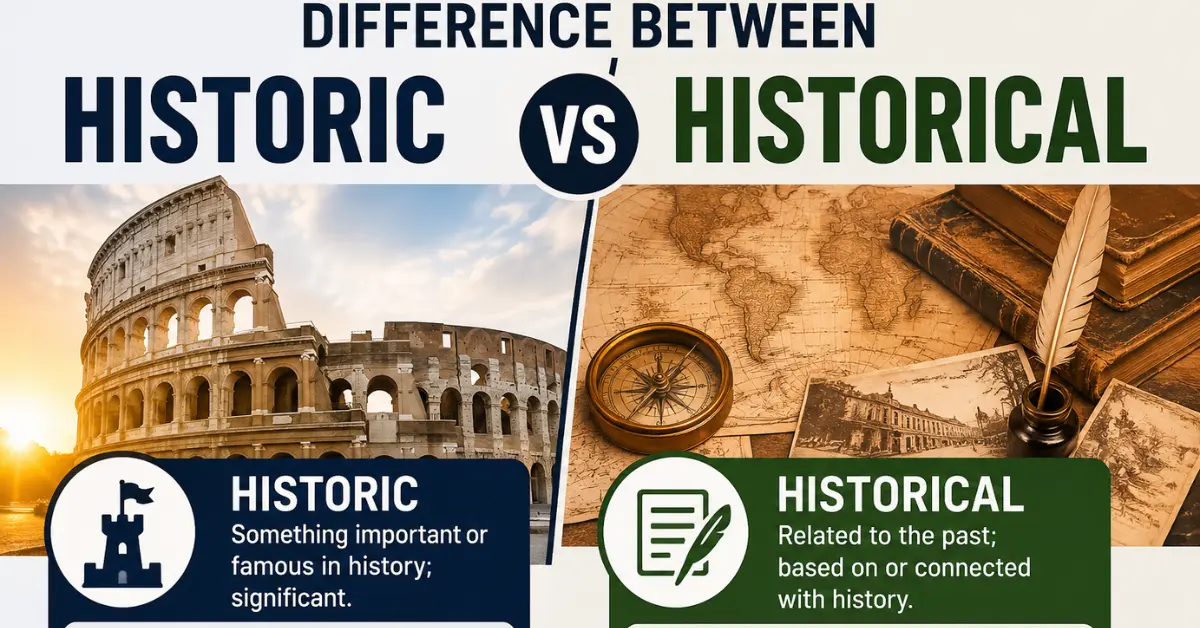
If you are confused about the difference between historic vs historical, you are not alone. These two words look almost the same, sound very similar, and both relate to the past. Because of this, many people use them interchangeably without realizing that they have slightly different meanings.
The good news is that understanding the difference is actually simple. In short, historic is used for something important or memorable in history, while historical refers to anything connected to history or the past.
For example, the moon landing was a historic event because it changed history. A textbook about the moon landing is historical because it talks about past events.
In this guide, you will learn everything about the difference between historic vs historical, including meanings, examples, grammar rules, common mistakes, memory tricks, and real-life usage so you never confuse them again.
Why Do People Confuse Historic and Historical?
Many English learners and even native speakers struggle with these two words because both come from the word history. At first glance, they appear to mean the same thing.
However, there is one important difference: importance.
When something is called historic, it means the thing had an important impact on history or is likely to be remembered for a long time. On the other hand, historical simply means something connected to history, whether important or not.
This small difference completely changes how each word should be used in writing and speaking.
Quick Difference Between Historic vs Historical
Here is the easiest way to understand them:
- Historic = Important in history
- Historical = Related to history
Think of it this way:
- If something made history, use historic.
- If something is simply part of history, use historical.
For example:
- The signing of an important peace agreement was a historic moment.
- Researchers studied historical records from the war.
The peace agreement changed history, while the records simply relate to past events.
What Does Historic Mean?
The word historic describes something famous, important, or significant in history. It usually refers to major events, places, achievements, or decisions that people will remember for years.
Something described as historic often has long-term importance or emotional value.
Examples of Historic in Sentences
- The country celebrated a historic victory after decades of struggle.
- Landing on the moon was a historic achievement.
- The president announced a historic agreement between the two nations.
- The city is famous for its historic landmarks.
In all of these examples, the word shows that something was important enough to be remembered.
Common Things Described as Historic
You will often see historic used with:
- Historic event
- Historic moment
- Historic victory
- Historic speech
- Historic building
- Historic achievement
- Historic agreement
These phrases usually describe something meaningful or life-changing.
What Does Historical Mean?
The word historical refers to anything related to history, past events, or the study of the past. It does not necessarily mean something is important.
This word is much broader and can describe ordinary things connected to earlier times.
Examples of Historical in Sentences
- She enjoys reading historical novels.
- The museum contains many historical artifacts.
- Researchers examined historical documents.
- The professor discussed historical events in class.
In these examples, the focus is simply on the connection to history, not historical importance.
Common Things Described as Historical
You will often hear phrases such as:
- Historical records
- Historical documents
- Historical novels
- Historical evidence
- Historical research
- Historical society
These things are connected to the past, but they may not be especially famous or important.
The Main Difference Between Historic vs Historical
The easiest way to remember the difference between historic vs historical is to ask one question:
Is this thing important in history or simply related to history?
- If it is important, choose historic.
- If it is related to history, choose historical.
For example:
- Imagine a castle built 500 years ago.
- If the castle played an important role in a major war, it may be called a historic castle.
- If you are simply talking about the castle as an old structure from the past, you can call it a historical castle.
This small difference changes the meaning of your sentence.
Historic vs Historical: Side-by-Side Comparison
Although both words connect to history, their meanings are not identical.
Historic
- Refers to something important in history
- Used for memorable or major events
- Suggests significance
Historical
- Refers to anything related to history
- Used for objects, books, studies, or past information
- Does not suggest importance
For example:
- “The fall of the Berlin Wall was a historic event.”
- “The documentary explained the historical background of the Berlin Wall.”
The first sentence focuses on importance. The second focuses on information from the past.
Historic Building vs Historical Building
One of the biggest areas of confusion is buildings.
A historic building is a place with major historical importance. Perhaps an important event happened there, or a famous person lived there.
A historical building, however, is simply a building from the past or connected to history.
For example:
- A house where a famous president once lived could be called a historic house.
- An old building preserved for educational purposes may be described as a historical building.
In everyday English, people often say historic building because it sounds more natural when discussing famous old places.
Historic Event vs Historical Event
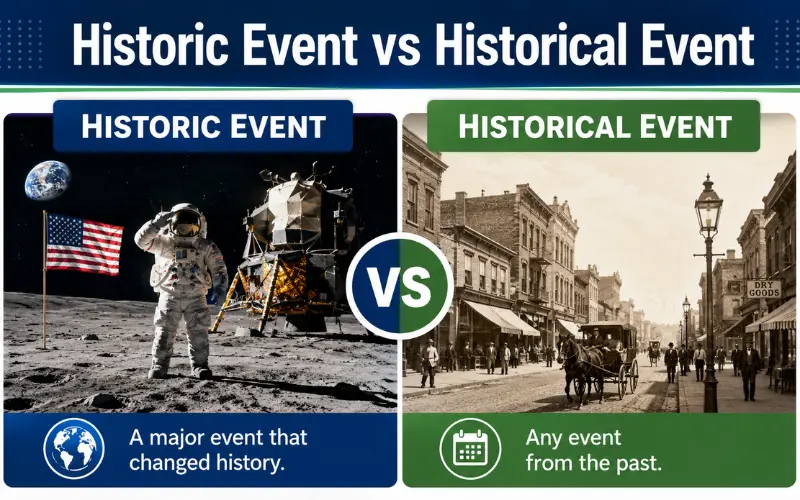
Another common confusion happens with events.
- A historic event is an event important enough to shape history.
- A historical event is simply an event from the past.
For example:
- The first successful moon landing was a historic event because it changed space exploration forever.
- A village meeting that happened 200 years ago may be a historical event, but not necessarily historic.
This difference may seem small, but it matters in formal writing and SEO-focused content.
A Historic or An Historic: Which Is Correct?
Many people also wonder whether they should write a historic or an historic.
Today, a historic is more common and generally considered correct in modern English because the “H” sound is clearly pronounced.
Examples:
- It was a historic moment.
- We witnessed a historic victory.
You may still hear an historic, especially in older British English or formal speech. This usage comes from a time when some speakers did not strongly pronounce the “H.”
However, for modern blogs, business writing, schools, and websites, a historic is usually the better choice.
A Historical or An Historical?
The same grammar rule applies to historical.
Most people now say:
- A historical event
- A historical document
Although an historical still appears occasionally, it sounds more formal or old-fashioned.
For modern writing, a historical is the safer and more natural option.
Common Mistakes People Make
- Many writers accidentally use historic for anything old.
This is incorrect.
- Something old is not automatically historic.
For example:
- Incorrect:
“This is a historic chair from the 1800s.” - Better:
“This is a historical chair from the 1800s.”
Unless the chair belonged to a famous historical figure or played a major role in history, historical works better.
Another common mistake is using historical for major events.
- Incorrect:
“The moon landing was a historical moment.” - Better:
“The moon landing was a historic moment.”
Because the moon landing changed history, historic is the stronger and more accurate word.
Easy Memory Trick to Remember the Difference
If you forget which word to use, remember this simple trick:
- Historic = History-making
- Historical = History-related
This quick memory rule can instantly help you choose the correct word.
For example:
- A peace treaty that ended a war = historic
- A book explaining the treaty = historical
Simple, right?
Can Historic and Historical Sometimes Overlap?
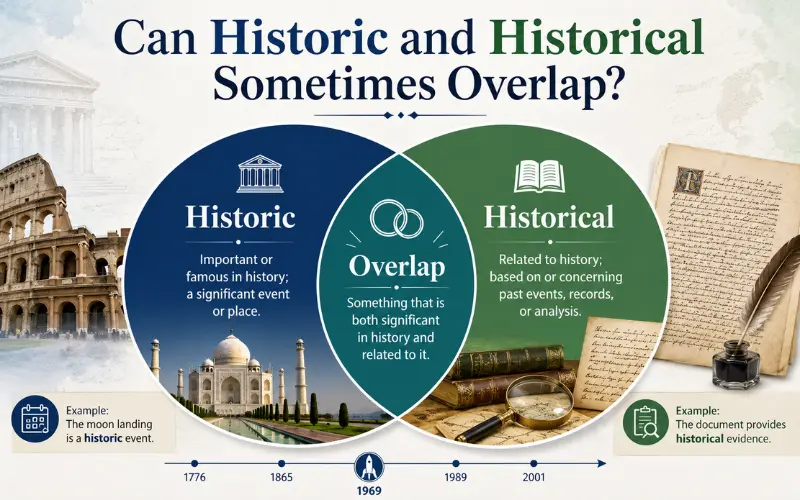
Yes, sometimes the meanings overlap.
There are situations where either word may technically make sense, but one usually sounds more natural.
For example:
- “This city has many historic places.”
- “This city has many historical places.”
Both are understandable, but historic places feels stronger because it emphasizes importance.
Writers usually choose the word depending on the meaning they want to communicate.
Why Using the Correct Word Matters
Using the wrong word may not completely confuse readers, but it can weaken your writing.
When you choose the right word, your content becomes:
- More professional
- Easier to understand
- Grammatically accurate
- More trustworthy to readers
This is especially important in essays, blogs, academic writing, journalism, and SEO content.
Correct word choice improves readability and authority.
FAQs
What is the difference between historic vs historical?
The difference between historic vs historical is simple. Historic means important in history, while historical means related to history or past events.
Is it historic or historical event?
Use historic event for an important event that changed history. Use historical event for an event simply connected to the past.
Should I say a historic or an historic?
In modern English, a historic is more common because the “H” sound is pronounced.
Is historical the same as historic?
No, they are not exactly the same. Historic emphasizes importance, while historical simply refers to something connected to history.
Can something be both historic and historical?
Yes, sometimes something can be both. An important event from the past can be historical because it belongs to history and historic because it changed history.
Why do people confuse historic and historical?
People confuse them because both words come from “history” and have similar meanings. The main difference is importance versus connection to the past.
Conclusion
Understanding the difference between historic vs historical is easier than most people think. The key thing to remember is that historic describes something important or memorable in history, while historical simply describes something connected to the past.
Whenever you feel confused, ask yourself one simple question: Did this thing make history, or is it just related to history?
- If it made history, choose historic.
- If it relates to history, choose historical.
Once you understand this simple rule, using these two words correctly becomes much easier in everyday writing and conversation.
You May Also Like It:
Difference Between Immigrate and Emigrate
Difference Between Time Flies vs Time Flys
