
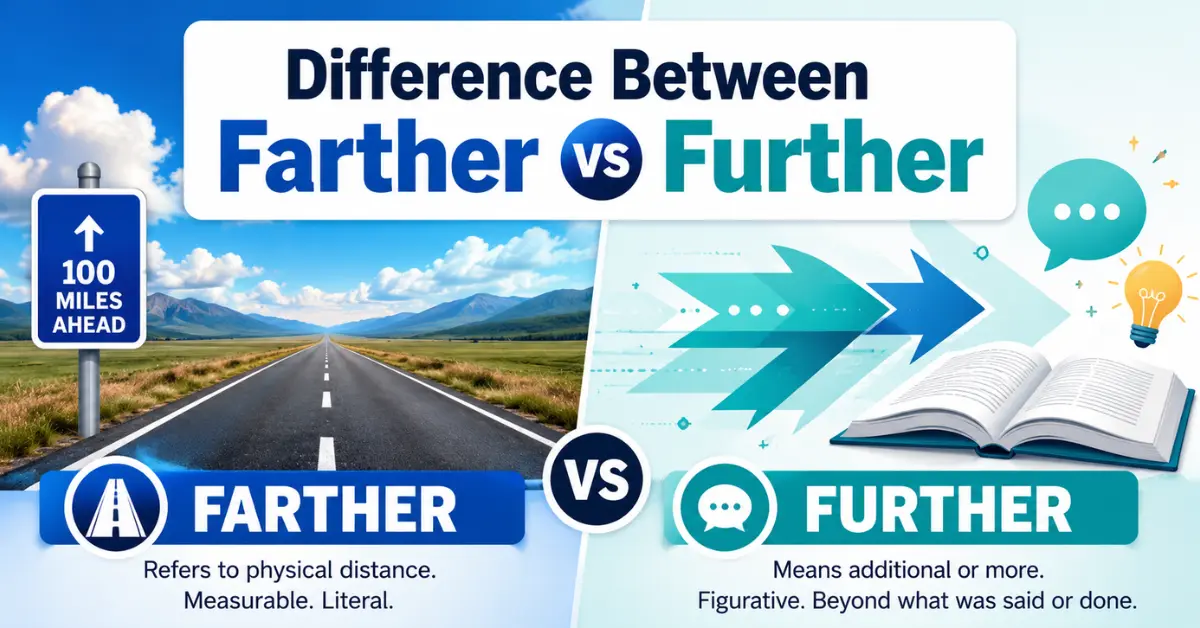
The difference between farther vs further can confuse many English learners and even native speakers. Both words come from the word far, and both can sometimes mean “more distant.” However, they are not always used in the same way.
The simple rule is this: use farther for physical distance and further for additional meaning, figurative distance, or progress.
For example:
- The school is farther from my house than the park.
- Please contact us for further information.
In the first sentence, farther talks about real distance. In the second sentence, further means more or additional information.
This guide explains the difference clearly with easy examples, common mistakes, usage rules, and simple tips so you can use both words correctly.
Quick Answer: Farther vs Further
- Use farther when you are talking about physical distance that can be measured.
- Use further when you mean additional, more, extra, figurative distance, or progress.
Examples:
- Farther: We walked farther down the road.
- Further: We need further details before making a decision.
A simple memory trick is:
- Farther has “far” in it, so use it for distance.
- Further means more, extra, or progress.
However, there is one important point. In everyday English, especially in British English, further is also commonly used for physical distance. Still, if you want the safest and clearest rule, use farther for measurable distance and further for everything else.
What Does Farther Mean?
Farther means “at, to, or by a greater physical distance.” It usually refers to real distance between people, places, or objects.
Examples:
- The airport is farther than the train station.
- She moved farther away from the crowd.
- We drove farther into the countryside.
- His house is farther from school than mine.
- The farther side of the river was covered with trees.
In these examples, the distance is physical. You can measure it in miles, kilometers, meters, feet, or steps.
More Examples of Farther
- Correct: The hotel is farther from the beach than we expected.
- Correct: He threw the ball farther than his brother.
- Correct: We cannot walk any farther today.
- Correct: The shop is a little farther down the street.
If you are talking about a place, direction, road, journey, or measurable distance, farther is usually the better choice.
What Does Further Mean?
Further has more uses than farther. It can mean:
- more
- extra
- additional
- to a greater degree
- figurative distance
- to advance or promote something
Examples:
- Please send me further information.
- We need further discussion before we decide.
- No further action is required.
- She took further training after college.
- This course will further your career.
In these examples, further does not mainly talk about physical distance. It means more information, more discussion, extra action, or progress.
Main Difference Between Farther and Further
The main difference is simple:
- Farther is mainly for physical distance.
- Further is mainly for additional meaning, figurative distance, or progress.
Here is an easy comparison:
| Word | Main Use | Example |
|---|---|---|
| Farther | Physical distance | The market is farther than the school. |
| Further | More or additional | Read the further instructions below. |
| Further | Progress or advancement | She wants to further her education. |
| Further | Figurative distance | Nothing could be further from the truth. |
Use Farther for Physical Distance
Use farther when you are talking about real distance.
Examples:
- Lahore is farther from Karachi than Hyderabad.
- The second shop is farther down the road.
- I parked farther away from the entrance.
- We walked farther than we planned.
- The mountain looked farther than it really was.
Ask yourself this question:
Can this distance be measured?
- If the answer is yes, farther is usually correct.
Example:
- The library is farther from my home than the gym.
This distance can be measured, so farther works well.
Use Further for Additional Meaning
Use further when you mean more, extra, or additional.
Examples:
- For further details, call our office.
- Further information is available on the website.
- We need further evidence.
- The teacher gave further instructions.
- The company made a further announcement.
This is one of the clearest differences between the two words. You should not use farther when you mean additional.
Incorrect:
- Please send farther information.
Correct:
- Please send further information.
Why? Because information is not physical distance. You are asking for more information, so further is correct.
Use Further as a Verb
Another important difference is that further can be used as a verb, but farther normally cannot.
As a verb, further means to help something progress, develop, or move forward.
Examples:
- She studied hard to further her career.
- The new policy may further economic growth.
- He joined the course to further his education.
- The project aims to further scientific research.
- Better communication can further understanding between teams.
Incorrect:
- He wants to farther his career.
Correct:
- He wants to further his career.
In modern English, farther is not normally used as a verb. If you mean advance, improve, or promote something, use further.
Farther vs Further as Adverbs
Both farther and further can be used as adverbs.
An adverb describes an action. When both words refer to distance, they can sometimes overlap.
Examples:
- We walked farther than yesterday.
- We walked further than yesterday.
Both sentences can be understood. However, in American English, many writers prefer farther for physical distance.
Better for physical distance:
We walked farther than yesterday.
But when the meaning is “more” or “to a greater degree,” only further sounds natural.
Correct:
- I do not want to discuss this further.
Incorrect:
- I do not want to discuss this farther.
Farther vs Further as Adjectives
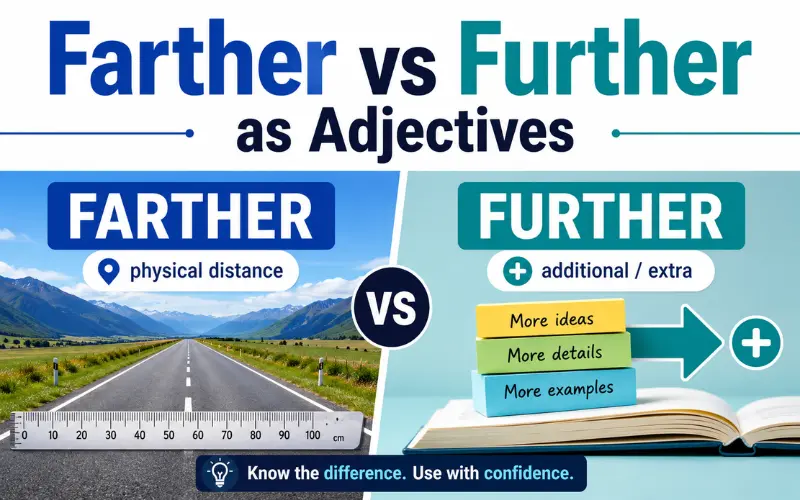
Both words can also work as adjectives.
When talking about distance, both may appear:
- The farther shore was hard to see.
- The further end of the hallway was dark.
However, when the meaning is additional, use further.
Examples:
- Further questions will be answered later.
- Further support may be needed.
- Further research is required.
- Further payment is not necessary.
Incorrect:
- Farther questions will be answered later.
Correct:
- Further questions will be answered later.
Farther Away or Further Away?
Both farther away and further away can be used when talking about distance.
Examples:
- The hospital is farther away than the clinic.
- The hospital is further away than the clinic.
Both are common, but farther away is often better when the meaning is physical distance.
Best choice for formal American English:
- The hospital is farther away than the clinic.
Still, further away is not wrong in many cases. It is especially common in British English and everyday speech.
Further Information or Farther Information?
The correct phrase is:
- Further information
Examples:
- Please contact us for further information.
- Further information will be shared soon.
- You can find further information in the guide.
Do not write:
- Farther information
That is incorrect because information is not a physical distance. You mean extra or additional information, so further is correct.
Further Education or Farther Education?
The correct phrase is:
- Further education
Examples:
- She is planning to continue her further education.
- Further education can improve career opportunities.
- Many students choose further education after school.
You should not say farther education because education is not a physical distance. Here, further means advanced, additional, or continued learning.
Further Questions or Farther Questions?
The correct phrase is:
- Further questions
Examples:
- Let me know if you have any further questions.
- Further questions will be answered after the meeting.
- Please email us for further questions or concerns.
Farther questions is incorrect because questions are not physical distance.
Further From the Truth or Farther From the Truth?
The correct and more natural expression is:
- Nothing could be further from the truth.
- This means something is completely false.
Examples:
- People say he is careless, but nothing could be further from the truth.
- The rumor could not be further from the truth.
- Her claim was further from the truth than she realized.
This phrase is figurative. Truth is not a physical place, so further is the better word.
Farther vs Further in American English
In American English, the common rule is:
- Use farther for physical distance.
- Use further for figurative distance, more information, or progress.
Examples:
- Farther: My office is farther from home now.
- Further: We need further research before publishing the report.
This rule is useful for students, writers, bloggers, editors, and anyone who wants clean formal writing.
Farther vs Further in British English
In British English, further is more commonly used than farther, even when talking about distance.
Example:
- We walked further down the road.
This sounds natural in British English. However, farther is still understood.
For international readers, the best approach is to follow the simple rule:
- Farther = physical distance
- Further = additional, figurative, or progress
This keeps your writing clear for both American and British audiences.
Farthest vs Furthest
The words farthest and furthest are the superlative forms of far. They mean “at the greatest distance” or “to the greatest degree.”
A helpful rule is:
- Farthest is often used for physical distance.
- Furthest is often used for figurative distance or general meaning.
Examples:
- He ran the farthest in the race.
- That is the farthest village from the city.
- This is the furthest we can take the discussion today.
- She went the furthest in explaining the problem.
But like farther and further, these words often overlap. Many people use furthest for physical distance too.
Example:
- This is the furthest I have ever traveled.
- That sentence is common and natural.
Common Mistakes with Farther and Further
Mistake 1: Using Farther for Information
Incorrect:
- For farther information, contact us.
Correct:
- For further information, contact us.
Use further because information means additional details, not physical distance.
Mistake 2: Using Farther as a Verb
Incorrect:
- This job will farther my career.
Correct:
- This job will further my career.
Use further when you mean advance or improve.
Mistake 3: Thinking Further Is Always Wrong for Distance
Some people think further can never be used for physical distance. That is not true.
Acceptable:
- We walked further down the road.
More traditional for physical distance:
- We walked farther down the road.
Both can be used, but farther is often clearer for physical distance.
Mistake 4: Using Farther in “Further Questions”
Incorrect:
- Let me know if you have farther questions.
Correct:
- Let me know if you have further questions.
Questions are not physical distance, so use further.
Mistake 5: Using Farther in “Further Education”
Incorrect:
- He wants to continue farther education.
Correct:
- He wants to continue further education.
Education is not a physical distance. Use further.
Easy Memory Trick
Here is the easiest way to remember the difference:
- Farther contains “far,” so use it for distance.
Example:
- The station is farther away.
Further means more, extra, or forward progress.
Example:
- This training will further your skills.
This trick works in most everyday situations.
Farther vs Further Examples
Examples with Farther
- The store is farther than I expected.
- She moved farther away from the fire.
- We drove farther into the desert.
- The farther hill was covered in snow.
- He can jump farther than his friend.
Examples with Further
- Please send further details.
- We need further discussion.
- No further action is needed.
- This plan will further our goals.
- I do not want to explain further.
Side-by-Side Sentence Comparison
Physical Distance
Correct:
- The park is farther from my house than the school.
Also common:
- The park is further from my house than the school.
Best formal choice:
- The park is farther from my house than the school.
Additional Meaning
Incorrect:
- Do you need farther help?
Correct:
- Do you need further help?
Career Progress
Incorrect:
- She wants to farther her career.
Correct:
She wants to further her career.
Figurative Meaning
Less natural:
- Nothing could be farther from the truth.
More natural:
- Nothing could be further from the truth.
Quick Rule for Writers
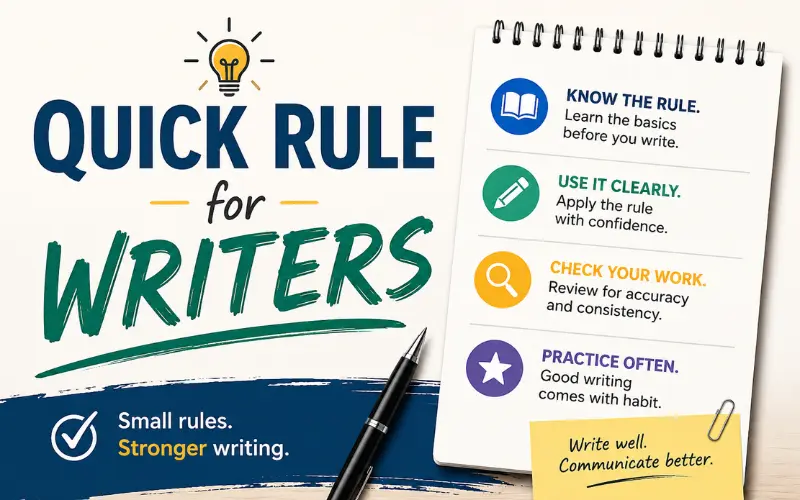
Use this simple rule when writing:
- Choose farther when you talk about physical distance.
Example:
- The new office is farther from the city center.
Choose further when you talk about more information, extra details, figurative distance, or progress.
Example:
- Further research is needed before we make a final decision.
This rule makes your writing clear, professional, and easy to understand.
Farther vs Further Quick Comparison
| Situation | Correct Word | Example |
|---|---|---|
| Physical distance | Farther | The bus stop is farther away. |
| More information | Further | Read further information below. |
| Extra questions | Further | Contact us for further questions. |
| Career progress | Further | She wants to further her career. |
| Figurative truth | Further | Nothing could be further from the truth. |
| Greatest physical distance | Farthest | He ran the farthest. |
| Greatest degree or extent | Furthest | This is the furthest we can go. |
FAQs
What is the main difference between farther and further?
The main difference is that farther usually refers to physical distance, while further means additional, more, figurative distance, or progress. For example, “The shop is farther away” talks about distance, while “I need further information” means more information.
Can further be used for physical distance?
Yes, further can be used for physical distance, especially in British English and everyday speech. However, in formal American English, farther is often preferred for measurable distance.
Is it further information or farther information?
The correct phrase is further information. Information is not a physical distance, so further is the right word. “Farther information” is incorrect.
Is it farther away or further away?
Both can be used, but farther away is usually better when you are talking about physical distance. For example, “The school is farther away than the park.” However, “further away” is also common in everyday English.
Is it further your career or farther your career?
The correct phrase is further your career. Here, further is a verb that means to advance, improve, or help something progress. Farther is not normally used as a verb.
Which is correct: nothing could be further or farther from the truth?
The more natural and common phrase is nothing could be further from the truth. This expression is figurative, not physical, so further is the better choice.
Conclusion
The difference between farther vs further is easy to understand when you follow one simple rule. Use farther for physical distance and further for additional meaning, figurative distance, or progress.
If you are talking about roads, places, miles, steps, or measurable distance, choose farther. If you mean more information, more discussion, extra help, career progress, or something non-physical, choose further.
So, write “The hotel is farther away” when you mean distance, but write “Contact us for further details” when you mean additional information. This simple rule will help you write more clearly, naturally, and professionally.
You May Also Like It:
Difference Between Immigrate and Emigrate
Difference Between Time Flies vs Time Flys
