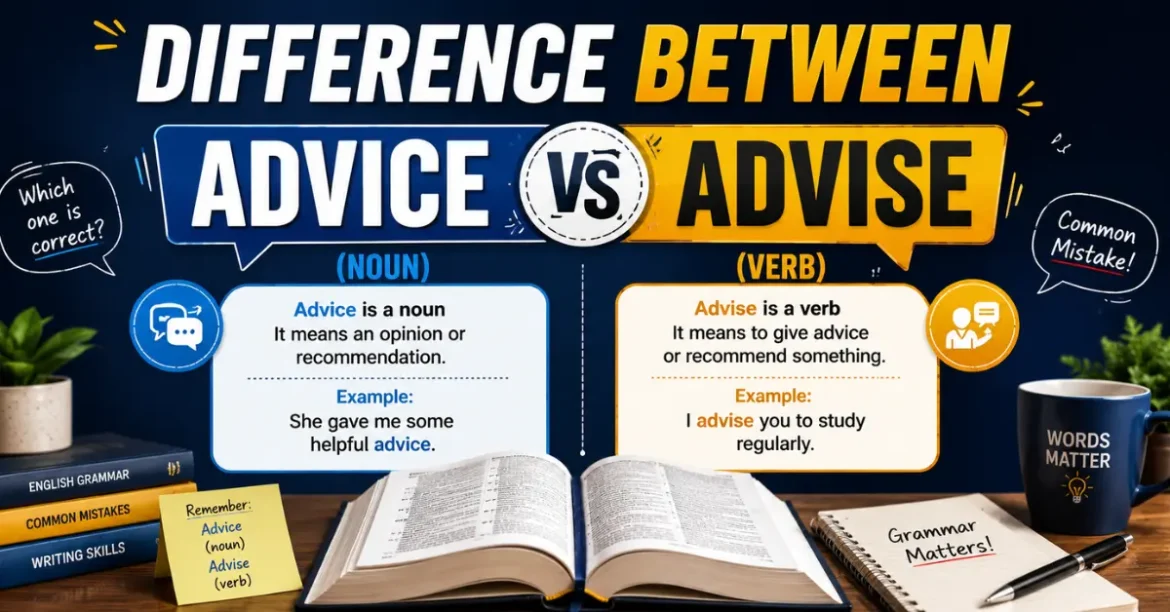
Understanding the difference between advice vs advise is important for clear and correct English writing. These two words look similar, sound similar, and are often confused—but they have completely different grammatical roles.
In this guide, you will learn the difference in the simplest way, with rules, examples, common mistakes, and memory tricks to help you never confuse them again.
Quick Answer
- Advice (noun) = suggestion or recommendation
- Advise (verb) = to give a suggestion or recommend something
Simply put:
- You give advice
- You advise someone
What is “Advice”?
Advice is a noun. It means a suggestion or recommendation that helps someone decide what to do.
Key Point:
You can give, take, or receive advice, but you cannot “advise advice.”
Examples of Advice
- I need your advice about my career.
- She gave me excellent advice on studying abroad.
- His advice helped me choose the right course.
- Always follow professional advice when dealing with legal matters.
Important Grammar Rule
an advice (incorrect)
advices (incorrect)
a piece of advice (correct)
some advice (correct)
“Advice” is uncountable, so it does not have a plural form.
What is “Advise”?
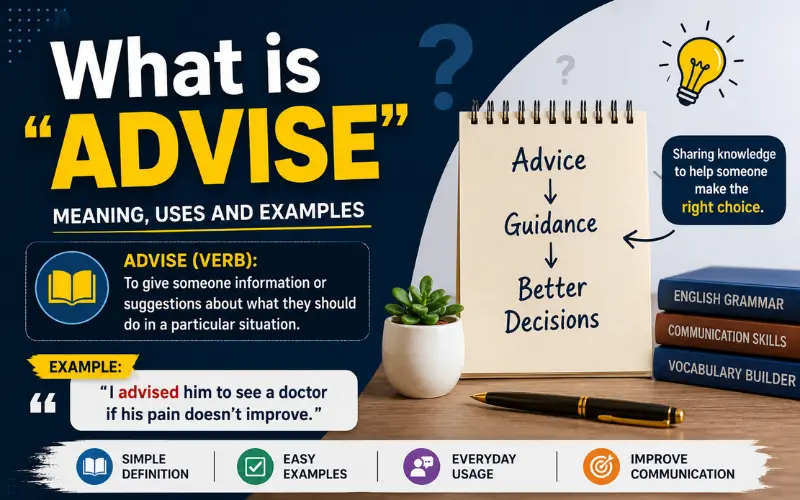
Advise is a verb. It means to give someone a suggestion or recommend an action.
Key Point:
When you advise someone, you are performing an action.
Examples of Advise
- The doctor advised me to rest for a week.
- I advise you to apply early for admission.
- Teachers often advise students to practice daily.
- He advised her not to travel alone at night.
Verb Forms of Advise
Base form: advise
Past tense: advised
Present participle: advising
Third person: advises
Difference Between Advice vs Advise
| Feature | Advice | Advise |
|---|---|---|
| Part of Speech | Noun | Verb |
| Meaning | Suggestion | To give suggestion |
| Usage | Something you receive | Action you perform |
| Example | I need advice | I advise you |
Easy Memory Trick
Here is the simplest way to remember the difference:
Trick 1:
Advice = Ice (noun feels “solid”)
Advise = Verb action
Trick 2:
- You receive advice
- You advise someone
Trick 3:
Words ending in:
- -ice → noun (advice, practice, service)
- -ise → verb (advise, organise, realise)
Common Mistakes
Many learners confuse these in daily writing. Here are the most common errors:
Wrong:
- Can you give me an advise?
- I will advice you to study hard.
- She gave me many advices.
Correct:
- Can you give me advice?
- I will advise you to study hard.
- She gave me some advice.
Real-Life Usage
Understanding difference between advice vs advise is useful in:
1. Email Writing
- “Please advise on the next steps.”
2. Academic Writing
- “The teacher advised students to revise regularly.”
3. Business Communication
- “Kindly advise if any changes are required.”
4. Professional Settings
- Doctors, lawyers, and consultants often give advice and advise clients.
Pronunciation Difference
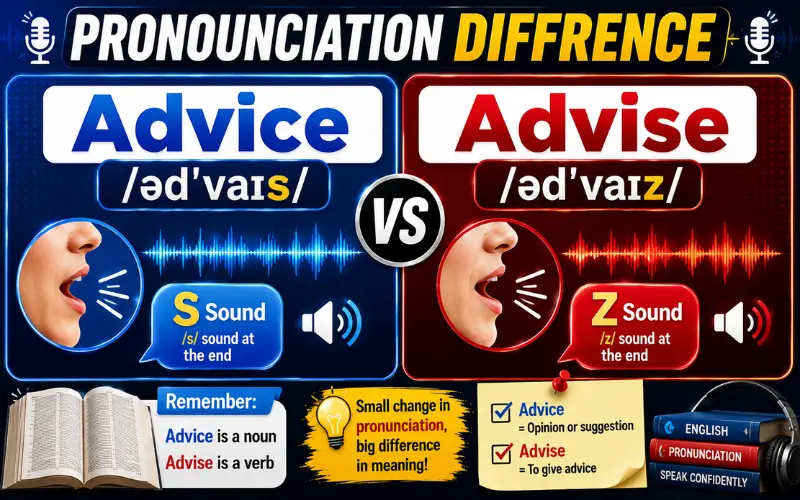
- Advice → /ədˈvaɪs/ (ends with “s” sound)
- Advise → /ədˈvaɪz/ (ends with “z” sound)
This small difference helps in spoken English too.
Quick Summary
- Advice = noun = suggestion
- Advise = verb = action of suggesting
- You take advice
- You advise someone
FAQs
What is the main difference between advice vs advise?
Advice is a noun meaning suggestion, while advise is a verb meaning to give a suggestion.
Can we say “an advice”?
No, advice is uncountable. You should say “a piece of advice.”
Is advise a noun or verb?
Advise is a verb used when someone gives suggestions or recommendations.
How do I remember advice and advise easily?
Advice ends with “ice” (noun), while advise ends with “ise” (verb).
Can advice be plural?
No, advice has no plural form. You can say “some advice” or “pieces of advice.”
Final Thoughts
The difference between advice vs advise is simple once you understand their grammar roles. One is a noun (advice), and the other is a verb (advise). Using them correctly improves your writing clarity, especially in academic, professional, and formal communication.
Master this difference, and you will avoid one of the most common English grammar mistakes.