
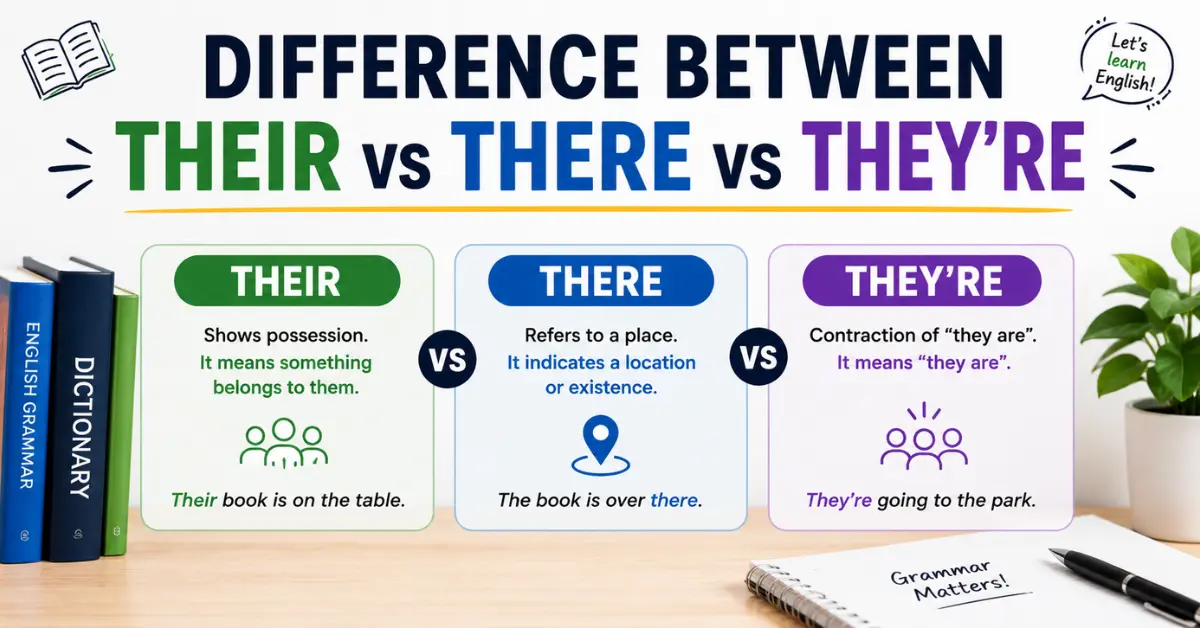
The difference between their vs there vs they’re is simple once you understand what each word does in a sentence. There is usually used for a place, position, situation, or existence. Their shows ownership or possession. They’re is a contraction that means they are.
These three words are confusing because they sound exactly the same. Words that sound the same but have different spellings and meanings are called homophones. Since your ears cannot tell the difference between them, you need to look at the meaning of the sentence.
Many students, English learners, writers, and even native speakers mix up there, their, and they’re in everyday writing. The mistake often happens in emails, school essays, social media captions, blog posts, comments, and text messages. The good news is that this grammar problem is easy to fix with a few simple rules.
In this guide, you will learn the meaning of there, their, and they’re, how to use each word correctly, how to avoid common mistakes, and how to remember the difference with easy examples.
Quick Summary: There vs Their vs They’re
Here is the fastest way to understand the difference:
| Word | Meaning | Use It For | Example |
|---|---|---|---|
| There | In that place, at that place, or used to introduce something | Place, position, or existence | There is a book on the table. |
| Their | Belonging to them | Ownership or possession | Their book is on the table. |
| They’re | They are | Contraction of “they are” | They’re reading a book. |
If you want the simplest memory rule, remember this:
- There = place or existence
- Their = ownership
- They’re = they are
This one rule can help you choose the correct word in almost every sentence.
Why Are There, Their, and They’re So Confusing?
The main reason these words are confusing is pronunciation. There, their, and they’re sound the same when spoken. In conversation, no one can hear the spelling difference.
For example, these three phrases sound the same:
- There going home
- Their going home
- They’re going home
Only one is correct:
They’re going home.
This is correct because the sentence means they are going home. The word they’re is the shortened form of they are.
This is why you should not choose between there, their, and they’re by sound. You should choose by meaning. Ask yourself what the sentence is trying to say. Is it talking about a place? Is it showing ownership? Does it mean they are?
What Does “There” Mean?
There is most often used to talk about a place or location. It can mean “in that place,” “at that place,” or “to that place.”
Example:
- I left my phone over there.
In this sentence, there tells us where the phone is. It points to a place.
Another example:
- We went there after dinner.
Here, there refers to a place people visited.
But there does not always mean a physical place. Sometimes it refers to a point, situation, idea, or stage in a conversation.
Example:
- I agree with your first point, but I disagree with you there.
In this sentence, there does not mean a real location. It means “at that point in the discussion.”
“There” Can Introduce Something
One important use of there is to introduce the existence of something. This usually happens with verbs like is, are, was, were, seems, and appears.
Examples:
- There is a problem with this sentence.
- There are many ways to improve your grammar.
- There was a loud noise outside.
- There were several people waiting near the door.
In these sentences, there does not show ownership. It also does not mean they are. It introduces something that exists or happens.
This is one of the most common uses of there, and it is also one of the most common places where people make mistakes.
Incorrect:
- Their is a problem with this sentence.
Correct:
- There is a problem with this sentence.
The sentence is not saying the problem belongs to someone. It is saying a problem exists. That is why there is correct.
Different Uses of “There”
The word there is more flexible than their and they’re. It can work in different ways depending on the sentence.
There for Place
Use there when you are talking about a location.
Examples:
- The keys are over there.
- I have never been there before.
- Please sit there until the meeting starts.
There for Existence
Use there when you are saying that something exists.
Examples:
- There is a mistake in your answer.
- There are five students in the room.
- There was no reason to panic.
There for a Point or Situation
Use there when you refer to a point in a story, argument, or situation.
Examples:
- That is where the problem started, right there.
- I understood the first part, but you lost me there.
- Let’s stop there and continue tomorrow.
What Does “Their” Mean?
Their shows ownership. It means something belongs to people, animals, a group, or sometimes one person whose gender is unknown or not important.
Example:
- The students opened their books.
The books belong to the students. That is why their is correct.
Another example:
- The players celebrated their victory.
The victory belongs to the players. Again, their shows possession.
The word their usually comes before a noun. The noun is the thing being owned.
Examples:
- their house
- their car
- their teacher
- their idea
- their problem
- their school
- their family
- their opinion
If the word shows that something belongs to someone, their is usually the correct choice.
“Their” Can Be Singular Too
Many people think their is only plural, but modern English also uses their for one person when the gender is unknown, not important, or when someone uses they/them pronouns.
Example:
- Someone left their wallet on the table.
Here, their refers to one unknown person. We do not know if the person is male or female, so their is natural and correct.
Another example:
- Every student should bring their notebook.
This sentence talks about any student in general. Instead of writing “his or her notebook,” many people use their notebook because it sounds smoother and more natural.
This use of their is common in everyday English, professional writing, and modern grammar style.
What Does “They’re” Mean?
They’re is a contraction. It means they are.
Example:
- They’re happy with the result.
This means:
- They are happy with the result.
The apostrophe in they’re shows that two words have been joined together. The missing letter is from the word are.
Another example:
- They’re going to the store.
This means:
- They are going to the store.
The easiest way to check they’re is to replace it with they are. If the sentence still makes sense, they’re is correct.
Example:
- They’re ready for the test.
Test:
- They are ready for the test.
The sentence still makes sense, so they’re is correct.
When Should You Use “They’re”?
Use they’re when the sentence talks about what people are doing, feeling, being, planning, or becoming.
Examples:
- They’re watching a movie.
- They’re feeling tired today.
- They’re my best friends.
- They’re working on a new project.
- They’re not ready yet.
In each example, you can replace they’re with they are.
- They are watching a movie.
- They are feeling tired today.
- They are my best friends.
- They are working on a new project.
- They are not ready yet.
That replacement test is the safest way to avoid mistakes.
There vs Their vs They’re: Full Explanation With Examples
The difference becomes easier when you compare the words in similar sentences.
Example 1
- There is a dog outside.
This means a dog exists outside.
- Their dog is outside.
This means the dog belongs to them.
- They’re outside with the dog.
This means they are outside with the dog.
Example 2
- There is a meeting today.
This introduces the meeting.
- Their meeting starts at 3 p.m.
This means the meeting belongs to them or is scheduled for them.
- They’re going to the meeting.
This means they are going to the meeting.
Example 3
- The books are over there.
This tells us the location of the books.
- Those are their books.
This tells us who owns the books.
- They’re reading the books.
This tells us what they are doing.
Easy Memory Tricks
Memory tricks can help you choose the right word quickly, especially when you are writing fast.
Remember “There” With “Here”
The word there contains here.
Both words are connected to place.
Examples:
- Here means this place.
- There means that place.
So when you are talking about location, there is often correct.
Example:
- The shop is over there.
Remember “Their” With Ownership
The word their shows that something belongs to people.
Example:
- That is their house.
The house belongs to them.
Remember “They’re” With “They Are”
The apostrophe in they’re reminds you that two words have been joined.
- They’re = they are
Example:
- They’re late.
This means:
- They are late.
If you cannot replace the word with they are, do not use they’re.
Quick Grammar Test Before Choosing the Word
Before you write there, their, or they’re, ask these three questions:
- Does the sentence mean they are?
- Use they’re.
- Does the sentence show ownership?
- Use their.
- Does the sentence talk about a place, position, situation, or existence?
- Use there.
This test works because each word has a different job.
Example:
______ going to bring_____ bags over____.
Now check the meaning.
- The first blank means they are, so use they’re.
- The second blank shows ownership, so use their.
- The third blank talks about a place, so use there.
Correct sentence:
- They’re going to bring their bags over there.
Common Mistakes With There, Their, and They’re
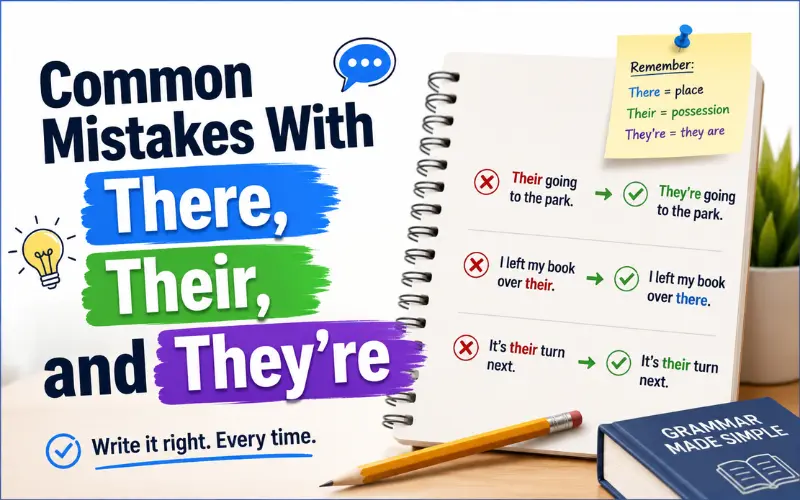
Many people make the same mistakes again and again. Here are the most common ones.
Mistake 1: Using “Their” Instead of “There”
Incorrect:
- Their is no reason to worry.
Correct:
- There is no reason to worry.
Why?
- The sentence is not showing ownership. It is saying that no reason exists. So there is correct.
Mistake 2: Using “There” Instead of “Their”
Incorrect:
- The kids forgot there homework.
Correct:
- The kids forgot their homework.
Why?
- The homework belongs to the kids. So their is correct.
Mistake 3: Using “Their” Instead of “They’re”
Incorrect:
- Their going to call us later.
Correct:
- They’re going to call us later.
Why?
The sentence means they are going to call us later. So they’re is correct.
Mistake 4: Using “They’re” Instead of “Their”
Incorrect:
- I like they’re new idea.
Correct:
- I like their new idea.
Why?
- The idea belongs to them. The sentence does not mean they are new idea, so they’re is wrong.
Mistake 5: Using “There” Instead of “They’re”
Incorrect:
- There waiting outside.
Correct:
- They’re waiting outside.
Why?
- The sentence means they are waiting outside. So they’re is correct.
Correct and Incorrect Examples
| Incorrect Sentence | Correct Sentence | Reason |
|---|---|---|
| Their is a problem. | There is a problem. | “There” introduces existence. |
| They forgot there bags. | They forgot their bags. | The bags belong to them. |
| Their coming soon. | They’re coming soon. | It means “they are coming.” |
| I saw they’re car. | I saw their car. | The car belongs to them. |
| There not ready. | They’re not ready. | It means “they are not ready.” |
This kind of comparison is one of the best ways to learn because it shows the mistake and the correction together.
Examples Using All Three Words in One Sentence
One of the best ways to understand the difference is to see there, their, and they’re in the same sentence.
Examples:
- They’re taking their books over there.
- There is a reason they’re proud of their work.
- I saw their car parked over there, so I think they’re already inside.
- They’re moving their furniture over there tomorrow.
- There are many students who improve their writing when they’re careful.
Each word has a separate meaning in these sentences. There points to a place or introduces something. Their shows ownership. They’re means they are.
Real-Life Examples for Better Understanding
In everyday writing, you might use these words without even thinking about them. That is why it is important to understand the difference clearly.
In a text message, you might write:
- They’re on their way there.
This sentence is short, but it uses all three words correctly. They’re means they are. Their shows that the way belongs to them as a phrase. There points to the place they are going.
In a school essay, you might write:
- There are many students who forget their homework because they’re in a hurry.
This sentence is also correct. There are introduces the students. Their homework means the homework belongs to the students. They’re in a hurry means they are in a hurry.
In a workplace email, you might write:
- There is a meeting at 10 a.m., and they’re bringing their reports.
This sentence sounds professional and clear. It uses each word correctly.
How to Use “There” in School Writing
Students often use there when introducing an idea, reason, example, or fact.
Examples:
- There are several reasons why exercise is important.
- There is strong evidence to support this argument.
- There were many changes after the new policy started.
In academic or school writing, there is and there are can be useful. However, you should not overuse them. Sometimes, a more direct sentence sounds stronger.
Weak sentence:
- There are many people who believe reading is important.
Stronger sentence:
- Many people believe reading is important.
Both sentences are correct, but the second one is more direct.
How to Use “Their” in Professional Writing
In professional writing, their is useful when talking about customers, employees, students, readers, users, or clients.
Examples:
- Customers should update their payment details.
- Employees must complete their training before Friday.
- Students can check their results online.
- Readers should choose the option that fits their needs.
The word their helps you write clearly without repeating names again and again.
How to Use “They’re” in Casual and Formal Writing
They’re is common in casual writing. You can use it in conversations, blog posts, emails, stories, and friendly messages.
Example:
- They’re excited about the new project.
However, in very formal writing, it is often better to use they are instead of they’re.
Formal version:
- They are excited about the new project.
Both versions are grammatically correct. The difference is tone. They’re sounds more conversational, while they are sounds more formal.
If you are writing an academic essay, business report, legal document, or official notice, use they are instead of they’re.
Difference Between “There Is” and “They’re”
Many people confuse there is and they’re, especially at the beginning of a sentence.
There is introduces something.
Example:
- There is a cat outside.
This means a cat exists outside.
They’re talks about people or things.
Example:
- They’re outside.
This means they are outside.
The difference is simple. There is introduces a noun. They’re replaces they are.
Difference Between “Their” and “They’re”
Their shows ownership. They’re means they are.
Example:
- Their car is new.
This means the car belongs to them.
Example:
- They’re buying a new car.
This means they are buying a new car.
A simple test is to replace the word with they are.
Sentence:
- Their car is new.
Test:
- They are car is new.
That does not make sense, so their is correct.
Difference Between “There” and “Their”
There is about place, position, existence, or situation. Their is about ownership.
Example:
- The dog is over there.
This tells us where the dog is.
Example:
- Their dog is friendly.
This tells us who owns the dog.
If you can replace the word with “in that place,” use there. If you can replace it with “belonging to them,” use their.
More Example Sentences
Here are more examples to make the difference clear.
Examples With “There”
- I will meet you there after lunch.
- There is no need to worry.
- The answer is right there in the paragraph.
- There are many ways to improve your writing.
- We stayed there for two nights.
- There was a strange noise outside.
Examples With “Their”
- The students submitted their assignments.
- The neighbors cleaned their garden.
- The players changed their strategy.
- The children packed their bags.
- The company improved their customer service.
- Everyone should check their email.
Examples With “They’re”
- They’re planning a trip.
- They’re not ready yet.
- I think they’re waiting for us.
- They’re working from home today.
- Do you know if they’re coming?
- They’re happy with the results.
Common Phrases With There, Their, and They’re
Some phrases appear often in English. Learning them can help you write faster and more accurately.
Common Phrases With “There”
- there is
- there are
- over there
- right there
- from there
- there was
- there were
- there seems to be
Examples:
- There is a solution.
- The shop is over there.
- There seems to be a delay.
Common Phrases With “Their”
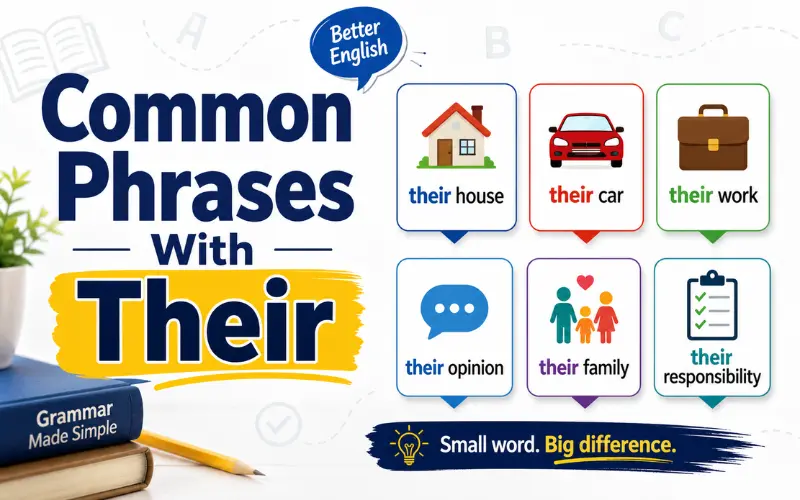
- their house
- their car
- their work
- their opinion
- their family
- their problem
- their decision
- their responsibility
Examples:
- That is their decision.
- I respect their opinion.
- The team completed their work.
Common Phrases With “They’re”
- they’re going
- they’re coming
- they’re ready
- they’re waiting
- they’re working
- they’re trying
- they’re happy
- they’re not sure
Examples:
- They’re waiting outside.
- They’re going to call tomorrow.
- They’re not sure about the answer.
Quick Cheat Sheet
Use this cheat sheet whenever you are unsure.
| If You Mean | Use | Example |
|---|---|---|
| In that place | There | Put it there. |
| Something exists | There | There is a problem. |
| Belonging to them | Their | Their house is big. |
| They are | They’re | They’re at home. |
A quick final test:
- Can you replace it with they are? Use they’re.
- Does it show ownership? Use their.
- Does it talk about place or existence? Use there.
FAQs
What is the difference between their vs there vs they’re?
The main difference between their vs there vs they’re is meaning. There is used for a place, position, situation, or existence. Their shows ownership or possession. They’re is a contraction that means they are. Although these words sound the same, they cannot be used in the same way in writing.
When should I use “there” in a sentence?
You should use there when you are talking about a place or when you want to show that something exists. For example, in the sentence “The bag is over there,” the word there points to a location. In the sentence “There is a problem,” the word there introduces the existence of a problem.
When should I use “their” in a sentence?
You should use their when something belongs to people, a group, animals, or even one person whose gender is unknown or not important. For example, “The students forgot their books” means the books belong to the students. The word their is always connected with possession or ownership.
When should I use “they’re” in a sentence?
You should use they’re when you mean they are. For example, “They’re coming to the party” means “They are coming to the party.” A simple way to check is to replace they’re with they are. If the sentence still makes sense, they’re is the correct word.
Why do people confuse there, their, and they’re?
People confuse there, their, and they’re because they are homophones. This means they have the same pronunciation but different spellings and meanings. The confusion usually happens in writing because you cannot hear the difference when the words are spoken.
What is the easiest way to remember there, their, and they’re?
The easiest way to remember the difference is to connect each word with its meaning. There is linked to place or existence, their is linked to ownership, and they’re means they are. If you check the meaning before writing, you can choose the correct word easily.
Final Thoughts
The difference between their vs there vs they’re becomes easy when you connect each word with its real meaning. There is used for a place, position, situation, or existence. Their shows that something belongs to people, a group, or a person. They’re is the short form of they are.
These three words sound the same, so it is normal to confuse them at first. But once you understand the difference between place, possession, and they are, you can avoid this mistake in school writing, emails, blog posts, social media captions, and everyday messages.
Before you write, pause for one second and ask yourself what you mean. If you mean a place or existence, write there. If you mean ownership, write their. If you mean they are, write they’re. That simple habit will make your writing cleaner, clearer, and more professional.
You May Also Like It:
Difference Between Immigrate and Emigrate
Difference Between Historic vs Historical
Difference Between Farther vs Further
