
Have you ever wondered whether you should say “fewer people” or “less people”? What about “10 items or less” versus “10 items or fewer”?
The difference between fewer vs less is one of the most commonly misunderstood grammar rules in English. While many people learn a simple rule in school, real-life English usage is often more flexible than most grammar guides suggest.
In this comprehensive guide, you’ll learn exactly when to use fewer and less, common exceptions, easy memory tricks, real-world examples, and the mistakes you should avoid.
Quick Answer: Fewer vs Less
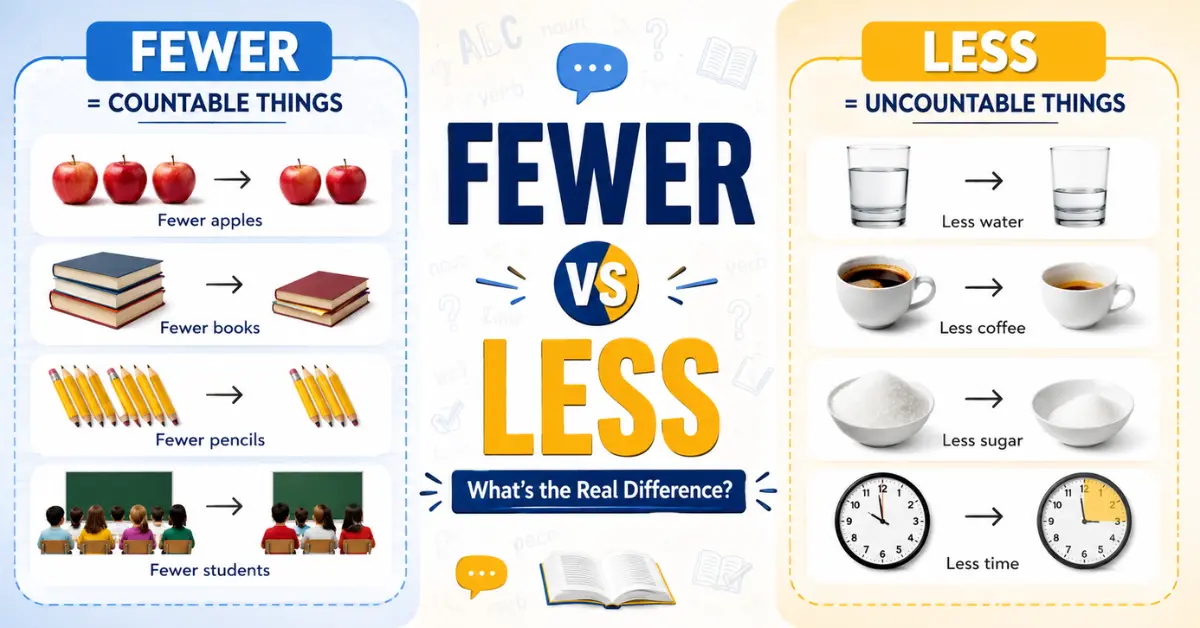
Use fewer when talking about things you can count individually.
Examples:
- Fewer students attended the meeting.
- I made fewer mistakes this time.
- There are fewer cars on the road today.
Use less when talking about things you cannot count individually.
Examples:
- I need less water.
- She spends less time watching TV.
- We have less information than before.
Simple Rule
- Countable noun = Fewer
- Uncountable noun = Less
- If you can count it one by one, use fewer.
- If you measure it as an amount, use less.
Understanding Countable and Uncountable Nouns
Before choosing between fewer and less, you need to know whether the noun is countable or uncountable.
Countable Nouns
Countable nouns can be counted individually.
Examples:
- Books
- Students
- Cars
- Cookies
- Mistakes
- Houses
Correct usage:
- Fewer books
- Fewer students
- Fewer mistakes
Uncountable Nouns
Uncountable nouns are measured as amounts rather than counted individually.
Examples:
- Water
- Milk
- Information
- Advice
- Time
Correct usage:
- Less water
- Less milk
- Less time
When to Use Fewer
Use fewer with plural nouns that can be counted.
Examples of Fewer
- Fewer employees
- Fewer customers
- Fewer errors
- Fewer visitors
- Fewer emails
Example Sentences
- Our company received fewer complaints this month.
- There were fewer participants than expected.
- I made fewer spelling mistakes after proofreading.
When to Use Less
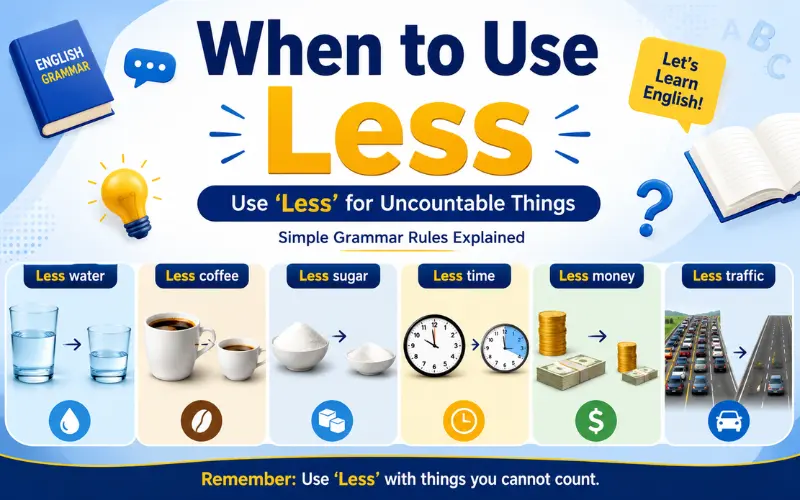
Use less with uncountable nouns that represent an amount, quantity, or degree.
Examples of Less
- Less water
- Less stress
- Less traffic
- Less pollution
- Less effort
Example Sentences
- I want less sugar in my coffee.
- The project required less effort than expected.
- We experienced less traffic during the holiday.
The Easy Memory Trick
A simple trick can help you remember the rule forever.
Ask Yourself This Question:
Can I count it one by one?
- If YES → Use fewer
- If NO → Use less
Examples:
Can you count books?
- Yes → Fewer books
Can you count water?
- No → Less water
Can you count people?
- Yes → Fewer people
Can you count happiness?
- No → Less happiness
Common Exceptions to the Rule
This is where many grammar articles stop, but understanding these exceptions is what helps you write naturally.
Money
Even though money can technically be counted, English usually treats it as an amount.
Correct:
- Less than $50
- Less than £100
- Less than 20 dollars
Less common:
- Fewer than 20 dollars
Why?
- When discussing money, we typically think about the total amount rather than individual units.
Time
- Time is usually treated as an amount.
Correct:
- Less than five years
- Less than ten minutes
- Less time spent online
Examples:
- She completed the project in less than a week.
- I spend less time commuting now.
Distance
Distance is generally treated as a measurement.
Correct:
- Less than three miles
- Less than ten kilometers
Example:
- The store is less than two miles away.
Weight and Measurements
Measurements usually take less, not fewer.
Examples:
- Less than 100 grams
- Less than 20 pounds
- Less than two liters
Percentages
Percentages depend on what is being measured.
Countable:
- Fewer than 10% of students passed.
Uncountable:
- Less than 10% of the water remained.
This is one of the most overlooked rules in many grammar guides.
Why Do Stores Say “10 Items or Less”?
Many people believe supermarket signs should say “10 Items or Fewer” because items are countable objects. According to the traditional grammar rule, fewer is used with things that can be counted individually, making “10 items or fewer” technically correct.
However, the phrase “10 Items or Less” has been used for centuries and remains widely accepted in everyday English. In this context, stores often treat the total number of items as a single quantity rather than as individual objects. Because of this, many people naturally use less instead of fewer.
This is why you’ll still see both “10 Items or Less” and “10 Items or Fewer” in supermarkets today. While grammar experts may prefer the latter, the former is deeply established in common usage and is understood by virtually everyone.
Why Native English Speakers Often Use Less with Countable Nouns
One reason people get confused is that native speakers regularly use less in situations where grammar books recommend fewer.
Examples heard in everyday speech:
- Less people showed up.
- Less cars are on the road.
- Less mistakes were made.
These phrases are common in conversation but are generally considered less formal.
For professional writing, academic work, and business communication, fewer remains the safer choice.
Common Mistakes to Avoid
Mistake #1
- Incorrect = Less students attended class.
- Correct = Fewer students attended class.
Mistake #2
- Incorrect = Less books were sold.
- Correct = Fewer books were sold.
Mistake #3
- Incorrect = Fewer water bottles were needed.
- Correct = Fewer bottles were needed.
OR
- Correct = Less water was needed.
Mistake #4
- Incorrect = Fewer information is available.
- Correct = Less information is available.
Fewer vs Less in Academic Writing
If you’re writing essays, reports, research papers, or business documents, following the traditional rule is recommended.
Formal Writing
- Fewer participants completed the survey.
- Fewer errors were detected.
- Less information was available.
Using the correct form can improve the professionalism of your writing.
Fewer vs Less in Business Writing
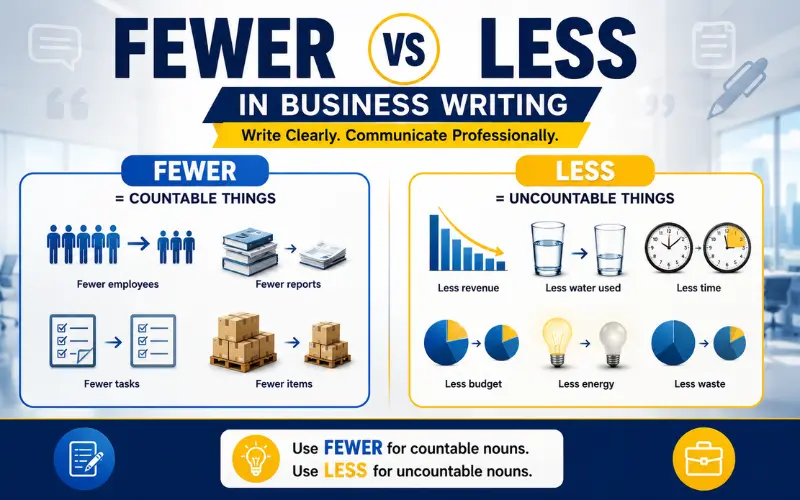
Business communication often requires precise language.
Examples
- The company received fewer complaints this quarter.
- We spent less money on advertising.
- Fewer employees worked remotely this year.
- Less downtime improved productivity.
Using the correct word helps your writing appear polished and credible.
Quick Comparison Table
| Situation | Correct Word | Example |
|---|---|---|
| Countable objects | Fewer | Fewer books |
| Countable people | Fewer | Fewer employees |
| Countable mistakes | Fewer | Fewer errors |
| Liquids | Less | Less water |
| Time | Less | Less time |
| Money | Less | Less money |
| Distance | Less | Less than 5 miles |
| Weight | Less | Less than 100 grams |
| Information | Less | Less information |
Fewer vs Less Cheat Sheet
Use Fewer for:
- People
- Books
- Cars
- Mistakes
- Students
- Houses
- Emails
Use Less for:
- Water
- Time
- Money
- Information
- Advice
- Traffic
- Pollution
Frequently Asked Questions
Is it fewer people or less people?
Fewer people is grammatically correct because people can be counted individually.
Is it less than 10 items or fewer than 10 items?
Traditional grammar recommends fewer than 10 items, but 10 items or less is widely accepted in everyday English.
Why do stores use “10 items or less”?
They often treat the total quantity as a single amount rather than separate items.
Is it less money or fewer money?
Less money is correct because money is usually treated as an amount.
Is it less time or fewer time?
Less time is correct because time is considered an uncountable quantity.
Is it fewer mistakes or less mistakes?
Fewer mistakes is correct because mistakes can be counted.
Can less be used with countable nouns?
Yes. Native speakers have used less with some countable nouns for centuries, especially when discussing time, money, distance, measurements, and quantities.
Final Thoughts
Understanding the difference between fewer vs less becomes easy once you remember one simple rule: use fewer for things you can count and less for things you cannot count.
However, English isn’t always strict. Exceptions involving money, time, distance, measurements, and common expressions mean you’ll sometimes see less used where traditional grammar expects fewer.
For formal writing, stick with the standard rule whenever possible. For everyday conversation, you’ll encounter both forms regularly. Knowing the difference allows you to write more accurately, communicate more clearly, and avoid one of the most common grammar mistakes in English.
You May Also Like It :
Difference Between Advice vs Advise
Difference Between Principle vs Principal
