
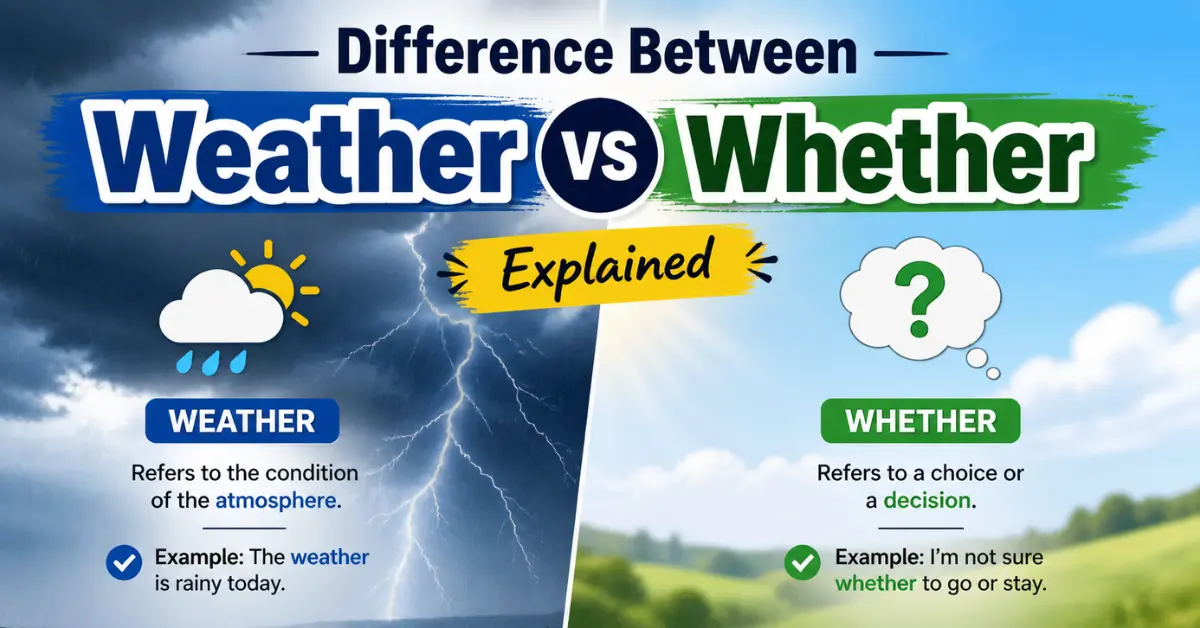
The key difference between weather and whether is simple: weather is about the sky and atmosphere, while whether introduces a choice or uncertainty. They sound identical when spoken — making them one of the most commonly confused word pairs in English.
Introduction:
“I don’t know weather she’s coming.”
Looks fine at first glance, right? But it’s wrong — and your spellchecker probably won’t catch it, because weather is a real word. The mistake only shows up to a careful reader.
Weather and whether are homophones — words that sound the same but have different spellings and completely different meanings. Understanding the difference between weather vs whether isn’t just about grammar rules. It’s about making sure your writing says exactly what you mean.
This guide covers everything: definitions, grammar rules, real-world examples, memory tricks, idioms, and the most common mistakes people make.
What Does “Weather” Mean?
Weather as a Noun
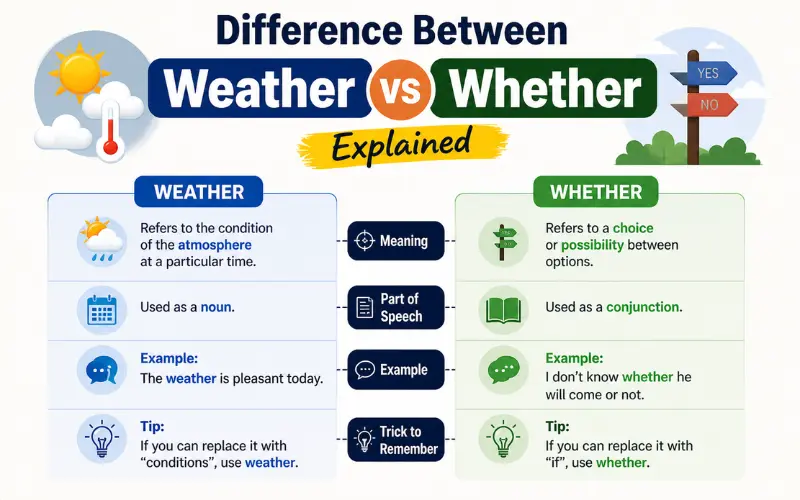
Weather (noun) describes the current state of the atmosphere — temperature, precipitation, wind, humidity, and so on. This is by far the most common use of the word, and it’s what most people picture when they hear it.
Examples:
- The weather is perfect for a morning run.
- Farmers depend on weather forecasts to plan their harvests.
- I always check the weather before deciding what to wear.
- The weather during our vacation was sunny every single day.
Weather as a Verb
Weather also works as a verb with two distinct meanings:
1. To physically expose something to the elements:
- The wind and rain had weathered the wooden fence over the years.
- The sculptor weathered the bronze statue intentionally to give it an antique finish.
2. To endure or survive a difficult situation (metaphorical):
- The team weathered a brutal losing streak before turning the season around.
- She weathered the criticism with grace and kept moving forward.
- Small businesses weathered the economic downturn better than expected.
Weather as an Adjective
In its past participle form, weathered can describe something worn or aged by exposure to the elements:
- The weathered stone walls gave the cottage a timeless, rustic feel.
- His weathered hands showed decades of hard outdoor work.
What Does “Whether” Mean?
Whether as a Conjunction
Whether is a conjunction — a word that connects ideas. It introduces two or more alternatives, expresses doubt or uncertainty, or signals that something is true in either case.
A helpful shortcut: in many sentences, whether can be replaced by if without changing the meaning.
Examples:
- I haven’t decided whether to accept the job offer.
- She asked me whether I wanted coffee or tea.
- No one knows whether the policy will work.
- He’ll show up whether we invite him or not.
Whether or Not: When Do You Need “Or Not”?
One of the most common questions about whether is whether you need to include “or not.”
In most cases, “or not” is optional:
- Tell me whether you’re coming.
- Tell me whether or not you’re coming.
Both sentences work fine. But “or not” becomes required when you mean regardless or no matter what:
- I’m going for a walk whether or not it rains. (= regardless of rain)
- I’m going for a walk whether it rains. (sounds incomplete without “or not”)
Rule of thumb: If you mean “no matter what happens,” always include “or not.”
Whether vs. If: Is There a Difference?
In informal speech, whether and if are often used interchangeably:
- Let me know whether you can make it. = Let me know if you can make it.
But there are situations where whether is correct and if is not:
1. At the start of a sentence (as the subject):
- Correct: Whether she attends is entirely her choice.
- Wrong: If she attends is entirely her choice.
2. Directly after a preposition:
- Correct: The discussion centered on whether the budget was realistic.
- Wrong: The discussion centered on if the budget was realistic.
Before “or not”:
Correct: I’ll finish the report whether or not you help me.
Wrong: I’ll finish the report if or not you help me.
4. In formal or academic writing: Whether is the preferred choice. It sounds more precise and professional than if.
The Core Difference Between Weather vs Whether
Here’s the clearest way to understand the difference:
Weather can be a noun, verb, or adjective:
- As a noun → The weather changed suddenly.
- As a verb → She weathered the challenge.
- As an adjective → The weathered barn door creaked.
Whether is only ever a conjunction:
- It connects clauses and introduces alternatives or doubt.
- It can never be a noun, verb, or adjective.
So if the word you’re reaching for describes the sky, rain, or wind — or means “to endure” — it’s weather.
If the word introduces a choice, a question, or an “either/or” situation — it’s whether.
Weather vs Whether: Common Idioms and Expressions
Idioms with “Weather”
- Under the weather — Feeling unwell or sick. “She called in sick; she’s been under the weather all week.”
- Weather the storm — To get through a difficult period. “The company weathered the storm and came out more resilient.”
- Weather permitting — If conditions allow. “We’ll hold the ceremony outdoors, weather permitting.”
- Fair-weather friend — Someone who is only supportive when things are easy. “He was a fair-weather friend — gone the moment things got tough.”
- Keep a weather eye on — To watch something carefully. “Keep a weather eye on the markets — things could shift quickly.”
- Come rain or shine — No matter the conditions. “She walks her dog every morning, come rain or shine.”
Expressions with “Whether”
- Whether or not — Regardless of the outcome; in either case. “I’m going to the concert whether or not the tickets are expensive.”
- Whether you like it or not — Emphasizing that something will happen regardless. “The changes are coming, whether you like it or not.”
Memory Tricks: How to Always Get It Right
Remember WEATHER
Trick 1: WEATHER contains “EAR” — you can hear the wind.
Trick 2: The “ea” in weAther stands for “Earth’s atmosphere.”
Trick 3: If it’s about rain, sun, or storms — it’s WEATHER. Think: a meteorologist reports the WEATHER.
Remember WHETHER
Trick 1: WHETHER has two H’s — just like a choice has two sides.
Trick 2: WHETHER = IF. Can you swap it with “if”? Then use WHETHER.
The Fastest Test
Ask yourself: “Am I talking about the sky or a choice?”
Sky → weather
Choice → whether
Common Mistakes: Weather vs Whether
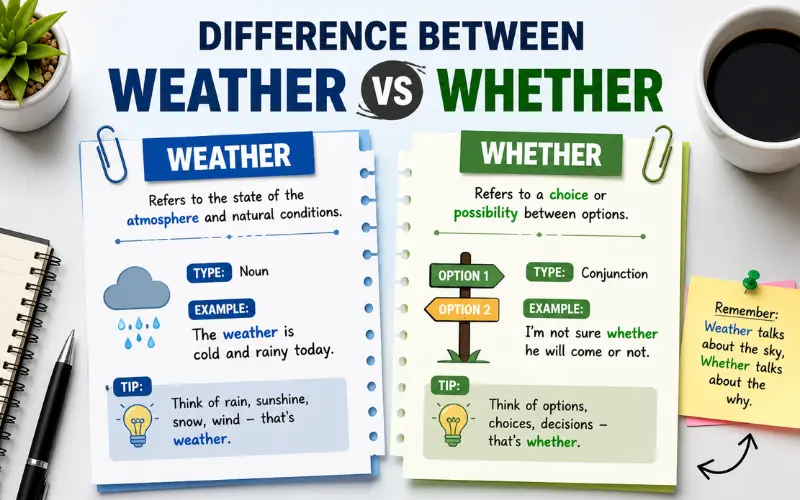
Here are the five most frequent errors writers make — and the correct version right next to them.
Mistake 1:
Wrong: I don’t know weather she’s telling the truth.
Right: I don’t know whether she’s telling the truth.
Why: Expressing doubt = conjunction = WHETHER.
Mistake 2:
Wrong: We’ll whether this difficult period together.
Right: We’ll weather this difficult period together.
Why: To endure = verb = WEATHER.
Mistake 3:
Wrong: The whether forecast says rain tomorrow.
Right: The weather forecast says rain tomorrow.
Why: Atmospheric conditions = noun = WEATHER.
Mistake 4:
Wrong: It’s weather or not you believe it — it’s true.
Right: It’s whether or not you believe it — it’s true.
Why: “Whether or not” = regardless = WHETHER.
Mistake 5:
Wrong: She looked whether-beaten after the long hike.
Right: She looked weather-beaten after the long hike.
Why: Worn by the elements = WEATHER.
Real-World Examples in Different Writing Contexts
Professional / Business Writing
- The CEO confirmed the company would weather any economic headwinds.
- The committee debated whether to postpone the product launch.
- Whether the merger proceeds depends on regulatory approval.
- The quarterly results will show whether the new strategy is working.
Academic / Formal Writing
- Researchers studied whether diet affects cognitive performance in adolescents.
- The report examines whether current climate policy is sufficient.
- Extreme weather events are increasing in frequency and intensity.
- The study explores whether early intervention leads to better long-term outcomes.
Everyday / Casual Writing
- I can’t decide whether to cook dinner or order takeout.
- What’s the weather like where you are right now?
- She’s coming to the party whether she’s invited or not.
- The weather app says it will be cloudy all week.
Quick-Reference Summary
Use WEATHER when:
- You’re talking about rain, sunshine, wind, or temperature.
- You mean to endure or survive a hard period (verb).
- You’re describing something worn by the elements (weathered).
- The phrase is: under the weather / weather the storm / weather permitting.
Use WHETHER when:
- You’re introducing two or more alternatives.
- You’re expressing doubt or uncertainty.
- You can substitute the word “if” without losing meaning.
- The phrase is: whether or not / whether you like it or not.
Frequently Asked Questions
Is “weather or not” ever correct?
No. The correct phrase is always whether or not. Weather is a noun or verb — it can never function as a conjunction. This is one of the most common errors in everyday writing.
Can I always replace “whether” with “if”?
In informal speech, often yes. But in formal writing, whether is preferred — especially at the start of a sentence, directly after a preposition, or before “or not.”
Why doesn’t spellcheck catch weather/whether mistakes?
Spellcheckers only flag misspelled words. Since both weather and whether are spelled correctly, the tool has no way to know which one you intended. Always proofread manually or use a grammar checker that reads context, not just spelling.
What is the difference between “weather” and “climate”?
Weather refers to short-term atmospheric conditions — what’s happening outside right now or in the coming days. Climate is the long-term pattern of those conditions in a region, measured over decades.
Can “whether” start a sentence?
Yes, absolutely. “Whether she attends is up to her” is grammatically correct. This is actually one of the cases where whether is required and if simply does not work.
Is “whether” formal or informal?
Whether is appropriate in both formal and informal contexts. In professional and academic writing, it is preferred over if because it sounds more precise and deliberate.
The One-Line Difference Between Weather vs Whether
Weather is what’s happening in the sky.
Whether is what’s happening in your decision.
Understand that one distinction — and you will never mix them up again.
