
Analytical verbs are powerful tools that improve your writing, thinking, and communication. Whether you’re writing an essay, report, or assignment, using the right analytical verbs helps you express ideas clearly and show critical thinking.
In this guide, you’ll learn:
- What analytical verbs are
- Why they matter
- Categorized lists (easy to use)
- Real examples in context
- When and how to use them correctly
What Are Analytical Verbs?

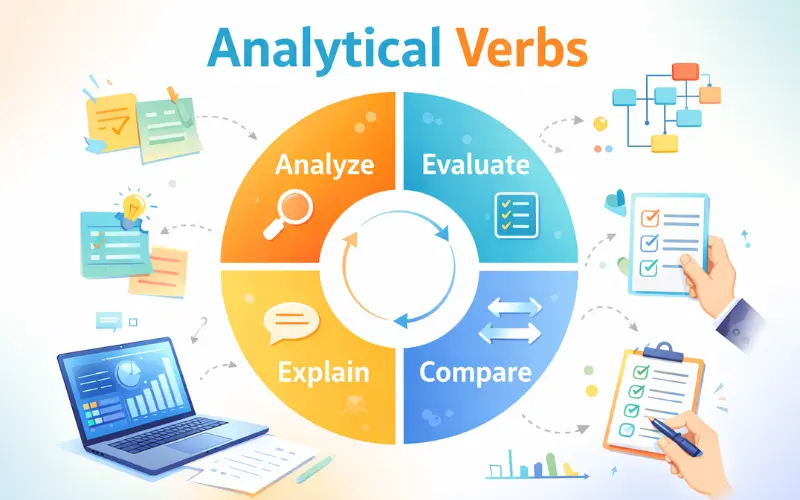
Analytical verbs are action words used to analyze, evaluate, compare, and explain ideas or information.
They help you go beyond basic writing and show deep understanding and critical thinking.
Simple Examples:
- Analyze → break something into parts
- Compare → show similarities
- Critique → evaluate strengths and weaknesses
- Explain → make something clear
Why Are Analytical Verbs Important?
Using analytical verbs can:
- Improve academic writing
- Show critical thinking skills
- Make your arguments clear and persuasive
- Help in exams, essays, and reports
- Strengthen professional communication
Types of Analytical Verbs (Organized for Easy Use)
Most articles just give long lists. Here’s a better approach—verbs grouped by purpose.
Analysis Verbs (Breaking Down Information)
Use these when examining details.
- Analyze
- Examine
- Investigate
- Explore
- Identify
- Break down
- Inspect
Example:
The study analyzes the impact of social media on students.
Comparison Verbs (Similarities & Differences)
Use these to compare ideas.
- Compare
- Contrast
- Differentiate
- Distinguish
- Relate
Example:
The article contrasts traditional and modern teaching methods.
Evaluation Verbs (Judging Value)
Use these to give opinions or judgments.
- Evaluate
- Assess
- Critique
- Judge
- Justify
Example:
The researcher evaluates the effectiveness of the new policy.
Argument Verbs (Presenting Ideas)
Use these in essays and debates.
Argue
Claim
Assert
Propose
Suggest
Example:
The author argues that climate change is accelerating rapidly.
Explanation Verbs (Clarifying Ideas)
Use these to explain concepts.
- Explain
- Describe
- Illustrate
- Define
- Outline
Example:
The report explains the causes of inflation.
Evidence-Based Verbs (Supporting Ideas)
Use these when using data or proof.
- Demonstrate
- Prove
- Support
- Validate
- Confirm
Example:
The data demonstrates a clear increase in sales.
Beginner to Advanced Analytical Verbs
This is something most competitors miss—difficulty levels.
Beginner Level
- Describe
- Explain
- Identify
- List
Intermediate Level
- Analyze
- Compare
- Discuss
- Interpret
Advanced Level
- Critique
- Synthesize
- Evaluate
- Justify
How to Use Analytical Verbs in Writing
Choose the Right Verb
Don’t just use “says” or “shows.”
Instead:
- Weak: The author says
- Strong: The author argues
Match the Verb to Your Purpose
- Explaining → “explains”
- Comparing → “contrasts”
- Evaluating → “critiques”
Use Them in Sentences Naturally
Example Paragraph:
The study analyzes the effects of online learning on student performance. It compares results from different regions and evaluates the effectiveness of digital tools. The findings suggest that online education can be effective when properly implemented.
Common Mistakes to Avoid
Using Simple Verbs
Avoid:
- says, shows, tells
Use:
- argues, demonstrates, highlights
Overusing the Same Verb
Don’t repeat:
- “The author argues…” again and again
Mix it up:
- argues, suggests, claims, emphasizes
Using the Wrong Verb
Example:
- “The author explains the weaknesses”
- “The author critiques the weaknesses”
Strong vs Weak Verbs
| Weak Verb | Strong Analytical Verb |
|---|---|
| Says | Argues |
| Shows | Demonstrates |
| Talks about | Discusses |
| Looks at | Examines |
| Thinks | Suggests |
Real-Life Use Cases
In Essays
- Analyze arguments
- Compare theories
- Evaluate evidence
In Reports
- Present findings
- Support conclusions
In Exams
- Answer questions clearly
- Show critical thinking
Pro Tips to Master Analytical Verbs
- Read academic articles and notice verb usage
- Practice writing daily
- Use different verbs in each paragraph
- Focus on meaning, not memorization
Final Thoughts
Analytical verbs are not just vocabulary—they are tools that improve how you think and write.
Instead of memorizing long lists, focus on:
- Understanding their purpose
- Using them correctly
- Applying them in real writing
When used properly, analytical verbs can make your writing more clear, professional, and impactful.
