
IELTS Writing Task 2 requires candidates to produce a well-organized essay that clearly responds to a specific question. Achieving a high band score depends on understanding task requirements, structuring ideas effectively, and using accurate language.
This guide provides a complete overview of IELTS Writing Task 2 and presents essential IELTS writing tips to help candidates improve their performance. It covers all key areas, including grammar, vocabulary, coherence, planning, practice, and feedback.
Understanding IELTS Writing Task 2

In Writing Task 2, candidates are required to write an essay of at least 250 words in approximately 40 minutes. The task presents a point of view, argument, or problem that must be addressed in a formal or semi-formal style.
Common question types:
- Opinion essays
- Discussion essays
- Problem and solution essays
- Advantages and disadvantages essays
Responses must remain focused on the specific issue presented in the question.
IELTS Writing Scoring Criteria
IELTS examiners assess writing based on four criteria:
Task Response
Candidates must address all parts of the question and present a clear, well-developed position.
Coherence and Cohesion
Ideas must be logically organized, with clear connections between sentences and paragraphs.
Lexical Resource
A range of vocabulary should be used accurately and appropriately.
Grammatical Range and Accuracy
A variety of sentence structures should be used with minimal errors.
Core Skills for IELTS Writing Success
Understanding the Question
Candidates should carefully identify the topic, focus, and task requirement. Writing off-topic may significantly reduce the score.
Planning the Essay
Effective planning helps organize ideas and ensures logical development.
Simple planning method:
- Identify the question type
- Choose two main ideas
- Add one example for each idea
Structuring the Essay
A clear structure improves readability and coherence.
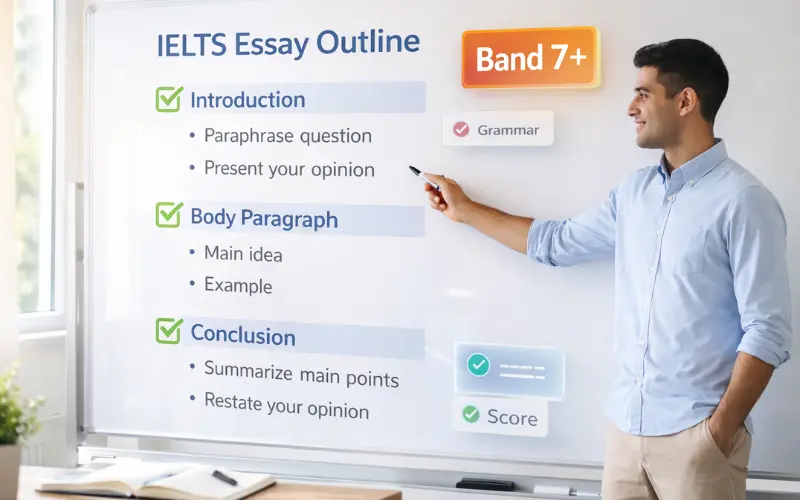
Standard essay structure:
Introduction
- Paraphrase the question
- Present a clear opinion
Body Paragraphs
- Each paragraph focuses on one idea
- Ideas are explained and supported
Conclusion
- Summarize key points
- Restate the position
IELTS Writing Vocabulary
Vocabulary plays an important role in achieving a higher band score. However, accuracy is more important than complexity.
Types of vocabulary to use:
Academic Words
- Increase, decrease, impact, benefit, challenge
Linking Words
- However, therefore, moreover, in addition
Topic Vocabulary
- Education: curriculum, learning methods
- Environment: pollution, climate change
Candidates should avoid using unfamiliar or overly complex words incorrectly.
Grammar for IELTS Writing
Grammatical accuracy is essential for clarity and coherence.
Common grammar areas to focus on:
- Subject-verb agreement
- Correct use of tenses
- Sentence structure
Sentence Types:
- Simple sentences
- Compound sentences
- Complex sentences
Using a variety of sentence types can improve the grammatical range score.
Coherence and Cohesion
Coherence refers to the logical flow of ideas, while cohesion refers to how ideas are connected.
How to improve coherence:
- Use clear paragraphing
- Focus on one idea per paragraph
- Maintain logical progression
Cohesive devices:
- Addition: furthermore, moreover
- Contrast: however, on the other hand
- Result: therefore, as a result
Overuse of linking words should be avoided.
Band Score Progression
Band 6
- Ideas are relevant but not fully developed
Band 7
- Ideas are clearly explained and supported
Band 8
- Ideas are precise, well-developed, and logically organized
Improvement depends on clarity, depth, and accuracy.
Common IELTS Writing Mistakes
- Not answering all parts of the question
- Poor organization of ideas
- Repetition of vocabulary
- Incorrect use of complex words
- Frequent grammar errors
Avoiding these mistakes can improve the overall score.
Practice Questions (Task 2)
Practicing different question types is essential.
Example questions:
- Some people believe that online education is more effective than traditional classroom learning. Discuss both views and give your opinion.
- In many countries, traffic congestion is increasing. What are the causes of this problem, and what solutions can be implemented?
- Some people think that governments should spend more money on public services rather than the arts. To what extent do you agree or disagree?
Sample Writing Approach
For each question:
- Identify the task type
- Plan two main ideas
- Write a clear introduction
- Develop each paragraph with explanation and examples
Feedback and Improvement
Improvement in IELTS writing requires regular feedback.
Methods for improvement:
- Self-assessment using IELTS criteria
- Reviewing model answers
- Identifying common mistakes
- Practicing under timed conditions
Constructive feedback helps candidates understand their weaknesses and improve effectively.
Time Management Strategy
A structured time plan is recommended:
- 5 minutes planning
- 30 minutes writing
- 5 minutes reviewing
Reviewing allows candidates to correct errors and improve clarity.
Final Checklist
Before submitting your essay, ensure:
- All parts of the question are answered
- The opinion is clearly stated
- Each paragraph contains one main idea
- Vocabulary is used appropriately
- Grammar errors are minimal
Conclusion
Achieving a high score in IELTS Writing Task 2 requires a clear understanding of task requirements, effective organization of ideas, and accurate use of language.
This guide covers all key areas of IELTS Writing, including grammar, vocabulary, coherence, planning, practice, and feedback, providing a complete resource for improving performance and achieving a higher band score.
