
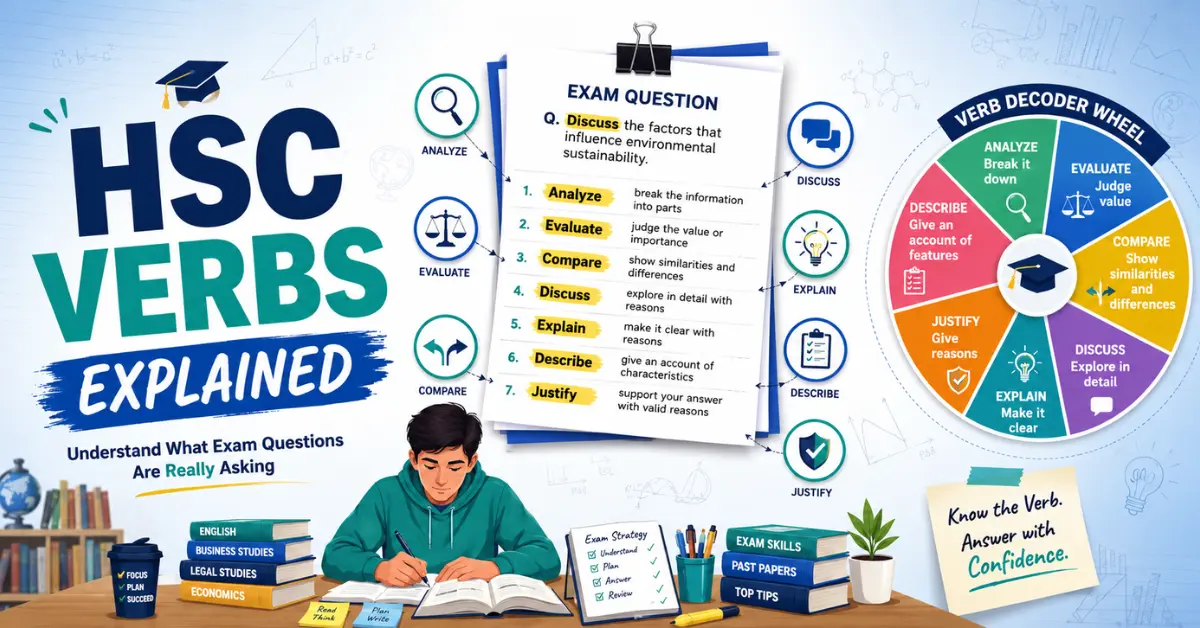
If you want to improve your HSC exam results, understanding HSC verbs is one of the smartest things you can do.
Words like analyse, evaluate, discuss, and justify appear in almost every HSC exam question. These directive verbs tell you exactly what the examiner wants.
Many students know the content but still lose marks because they misunderstand the verb in the question.
This guide explains every important HSC verb in plain English, with examples, answer formulas, and practical tips so you know exactly how to respond in your exams.
What Are HSC Verbs?
HSC verbs, also called directive terms or NESA key words, are instruction words used in exam questions.
They tell you:
- What type of response to write
- How much detail to include
- Whether to explain, compare, evaluate, or justify
- The depth of thinking required
Example:
Question: Analyse how the composer presents the idea of identity.
This question is not asking you to simply describe what happens. It requires you to:
- Break the text into parts.
- Examine the techniques used.
- Explain how these parts work together.
- Discuss the implications.
Why HSC Verbs Matter So Much
Understanding HSC verbs helps you:
- Answer the question accurately
- Meet the marking criteria
- Structure your response properly
- Avoid irrelevant information
- Maximise your marks
Even a well-written answer can score poorly if it does not address the directive verb.
Official NESA Definitions vs Student-Friendly Meanings
NESA provides formal definitions, but they can feel technical. This guide translates each verb into simple language so you know exactly what to do under exam conditions.
Quick Reference Table: Most Common HSC Verbs
| HSC Verb | Simple Meaning |
|---|---|
| Analyse | Break it down and explain how it works |
| Assess | Judge its effectiveness or importance |
| Compare | Show similarities and differences |
| Contrast | Show differences only |
| Describe | State the features |
| Discuss | Explore different viewpoints |
| Evaluate | Judge using evidence |
| Explain | Show why or how |
| Identify | Name it |
| Interpret | Explain the meaning |
| Justify | Support your answer with evidence |
| Outline | Give the main points |
| Summarise | Briefly condense the key ideas |
| To what extent | Decide how much you agree |
Complete List of HSC Verbs Explained
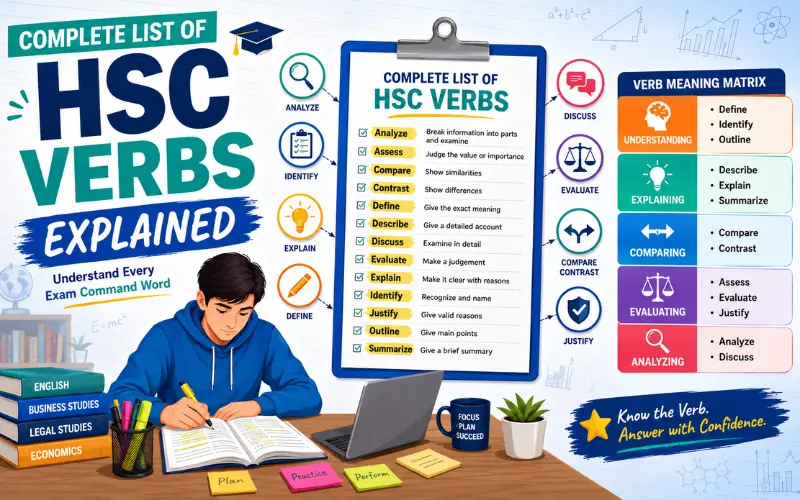
Analyse
NESA Definition: Identify components and the relationship between them; draw out implications.
Simple Meaning
Break something into parts and explain how those parts work together.
What the Marker Wants
- Detailed examination
- Cause and effect
- Significance
Example Question:
Analyse how symbolism develops the central theme.
Sentence Starter
The composer uses symbolism to reveal…
Assess
Simple Meaning: Judge how effective, significant, or important something is.
How to Answer
- Consider strengths and weaknesses
- Use evidence
- Reach a balanced judgment
Sentence Starter
Overall, this strategy is highly effective because…
Compare
Simple Meaning: Show similarities and differences.
Best Structure
- Similarity 1
- Difference 1
- Similarity 2
- Difference 2
Useful Linking Words
- Similarly
- Likewise
- In contrast
- However
Contrast
Simple Meaning: Focus only on differences.
Sentence Starter
Unlike Text A, Text B presents…
Describe
Simple Meaning: State characteristics or features.
Tip
Do not analyse unless the question asks for it.
Discuss
Simple Meaning: Explore multiple ideas or viewpoints.
What to Include
- Arguments for and against
- Different perspectives
- Evidence
- Conclusion
Evaluate
Simple Meaning: Make a judgment based on criteria and evidence.
Four-Step Formula
- State criteria.
- Explain strengths.
- Explain limitations.
- Reach a conclusion.
Explain
Simple Meaning: Show why or how something happens.
Formula
Point → Cause → Effect → Example
Identify
Simple Meaning: Name the required concept or feature.
Example
Identify one persuasive technique used in the text.
Answer
Repetition.
Interpret
Simple Meaning: Explain the meaning or significance.
Investigate
Simple Meaning: Examine evidence and draw conclusions.
Justify
Simple Meaning: Provide reasons and evidence to support your answer.
Sentence Starter
This approach is justified because…
Outline
Simple Meaning: Give the main points only.
Predict
Simple Meaning: Suggest what is likely to happen based on evidence.
Propose
Simple Meaning: Suggest a solution or recommendation.
Summarise
Simple Meaning: Condense the most important information.
Synthesise
Simple Meaning: Combine ideas from multiple sources to create a new understanding.
To What Extent
Simple Meaning: Decide how much you agree.
Strong Thesis Example
To a large extent, the text supports the idea that identity is shaped by conflict.
How Accurate
Simple Meaning: Evaluate how true a statement is.
In Your View
Simple Meaning: Provide your informed judgment in formal academic language.
With Reference To
Simple Meaning: Use quotations and examples as evidence.
Advanced Verbs Students Often Misunderstand
Critically Analyse
Analyse deeply while considering assumptions, limitations, and implications.
Critically Evaluate
Judge strengths and weaknesses with sophisticated reasoning.
Distinguish
Show the differences between two ideas.
Examine
Look at something closely and explain it in detail.
Account For
Give reasons for why something happened.
Demonstrate
Show by using examples or evidence.
HSC Verb Cheat Sheet by Cognitive Level
Basic Recall
- Identify
- Define
- Recall
- Name
Understanding
- Describe
- Explain
- Outline
- Summarise
Application
- Apply
- Calculate
- Demonstrate
Analysis
- Analyse
- Compare
- Contrast
- Distinguish
Evaluation
- Assess
- Evaluate
- Justify
- To what extent
Creation
- Propose
- Predict
- Synthesise
How to Decode Any HSC Question
Use this 5-step process:
- Circle the directive verb.
- Underline the topic.
- Note the mark value.
- Identify keywords and limitations.
- Plan your response.
Example
Question: Evaluate the effectiveness of fiscal policy in reducing unemployment.
- Verb: Evaluate
- Topic: Fiscal policy
- Focus: Reducing unemployment
- Task: Make a judgment using evidence
Recommended Response Length by Marks
| Marks | Suggested Length |
|---|---|
| 1 | One sentence |
| 2 | Two concise points |
| 3–4 | One developed paragraph |
| 5–6 | Two detailed paragraphs |
| 7–8 | Three developed paragraphs |
| 10+ | Full essay response |
Subject-Specific Examples
HSC English
Analyse how imagery conveys emotion.
HSC Economics
Assess the impact of interest rate changes.
HSC Biology
Explain the process of DNA replication.
HSC Modern History
Evaluate the significance of a historical event.
HSC Legal Studies
Discuss the effectiveness of legal and non-legal responses.
Command Words That Often Mean the Same Thing
| Similar Verbs | What They Usually Mean |
|---|---|
| Represent, portray, reflect | Show |
| Evaluate, assess | Judge |
| Compare, distinguish | Identify similarities and differences |
| Explain, account for | Show why/how |
| Outline, summarise | Briefly state main points |
Common Mistakes Students Make
Describing Instead of Analysing
Listing facts is not analysis.
Forgetting to Make a Judgment
Required for assess, evaluate, and to what extent.
Ignoring Mark Allocation
A 2-mark response should be concise.
Not Using Evidence
Support every key point.
Writing Generic Responses
Address the exact wording of the question.
Best Study Tips for Memorising HSC Verbs
- Create flashcards.
- Practise with past papers.
- Group verbs by type.
- Use sentence starters.
- Test yourself weekly.
Printable Sentence Starters for HSC Verbs
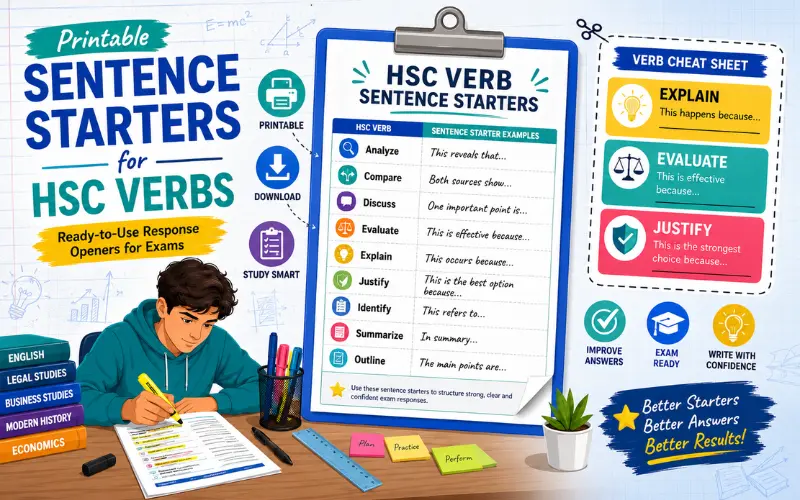
- Analyse: This reveals that…
- Assess: Overall, this was effective because…
- Compare: Both texts demonstrate…
- Contrast: In contrast…
- Discuss: One perspective suggests…
- Evaluate: This is significant because…
- Explain: This occurs because…
- Justify: This is supported by…
- To what extent: To a large extent…
Mini Practice Questions
- Analyse how conflict shapes identity.
- Discuss the impact of globalisation.
- Evaluate the success of a policy.
- Compare two characters.
- Explain the role of enzymes.
Try identifying the verb before writing your answer.
Frequently Asked Questions
What are HSC verbs?
HSC verbs are directive terms used in exam questions that tell you how to answer.
Where can I find the official HSC verbs list?
The official glossary is available from NESA
Which HSC verbs are most important?
Analyse, discuss, explain, evaluate, assess, justify, and compare.
What is the difference between analyse and explain?
Analyse breaks something into parts and discusses relationships. Explain shows why or how something happens.
What does “to what extent” mean?
You must decide how much you agree with a statement and support your judgment.
Are HSC verbs used in all subjects?
Yes. They appear in English, Maths, Science, Economics, History, Legal Studies, and more.
How do I remember all the verbs?
Use flashcards, practice questions, and group verbs by meaning
Final Thoughts
Mastering HSC verbs is one of the most effective ways to improve your exam performance.
When you understand exactly what words like analyse, evaluate, and justify require, your responses become more focused, relevant, and aligned with the marking criteria.
Before answering any HSC question, ask yourself:
What is the verb telling me to do?
Answer that correctly, and you are already giving yourself the best chance to earn full marks.
