
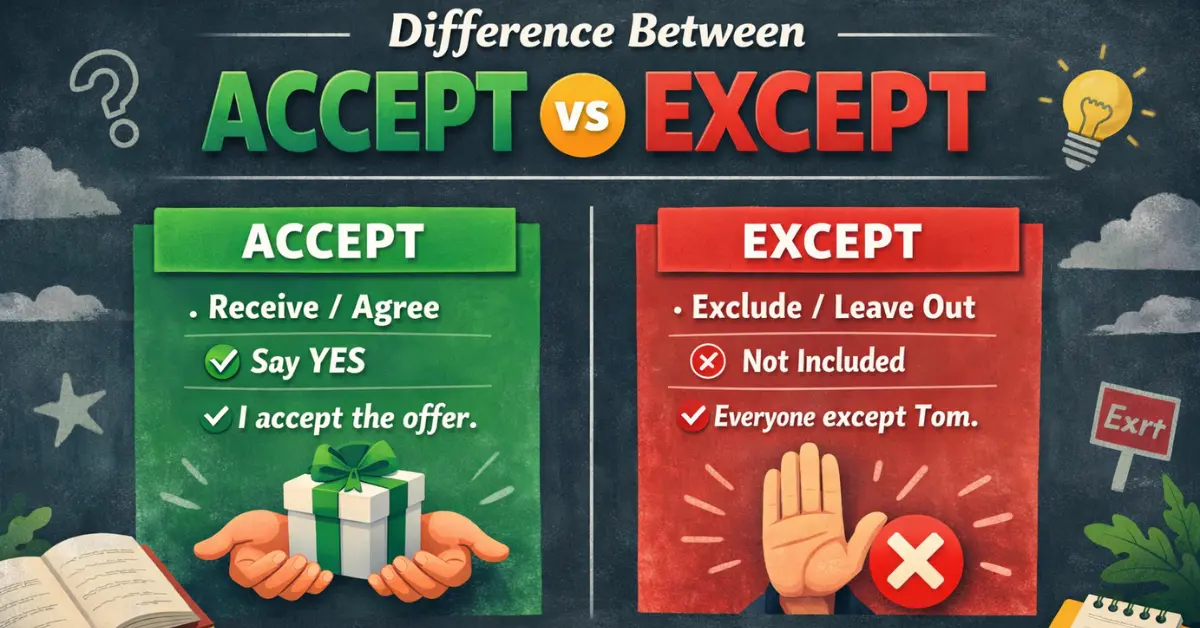
Many people confuse accept vs except because they sound alike, but their meanings are completely different.
Understanding the Difference Between Accept vs Except is important, especially if you want to write and speak English correctly.
If you use the wrong one, your sentence can become confusing or incorrect.
This guide will clearly explain the Difference Between Accept vs Except, with simple examples, clear rules, and easy tips you can remember.
Quick Difference
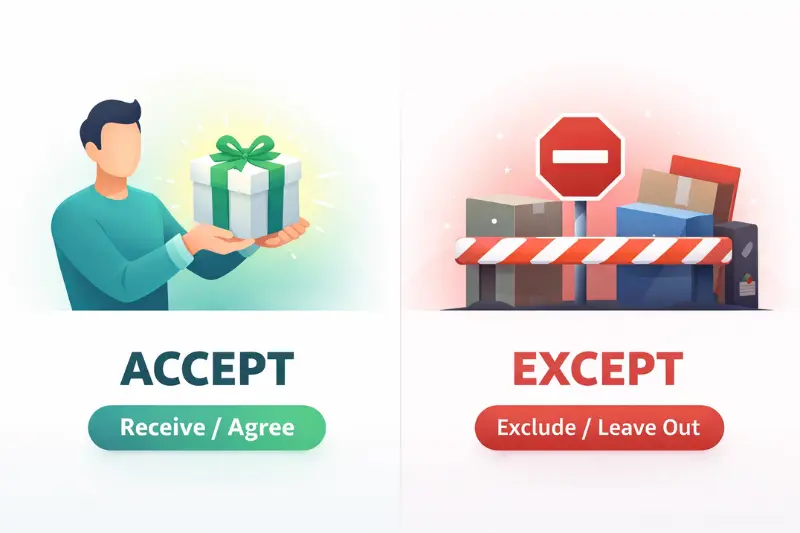
- Accept = to receive or agree
- Except = to exclude or leave out
Example:
- I accept your offer.
- Everyone came except Ali.
Accept vs Except (Side-by-Side Comparison)
| Feature | Accept | Except |
|---|---|---|
| Meaning | Receive / agree | Exclude / leave out |
| Part of Speech | Verb | Preposition / Conjunction |
| Use | Action word | Shows exception |
| Example | I accept the job | Everyone except John came |
What Is “Accept”?
Accept is always a verb, which means it shows an action.
Meaning:
- To receive something
- To agree to something
- To approve something
Examples:
- I accept your invitation.
- She accepted the apology.
- They accept the new policy.
Simple idea: Accept = Say YES
What Is “Except”?
Except is usually used to show something is not included.
Meaning:
To exclude something
To leave something out
Examples:
Everyone came except Ahmed.
I like all fruits except bananas.
We are open daily except Sunday.
Simple idea: Except = Remove something
Key Difference Between Accept vs Except
The easiest way to understand:
- Accept = Include something
- Except = Exclude something
One adds, the other removes.
Real-Life Examples
In Emails:
I accept your proposal.
Everything is fine except the deadline.
At Work:
She accepted the job offer.
All employees attended except one.
Daily Life:
He didn’t accept my advice.
Everyone is here except Sara.
Common Mistakes to Avoid
These are very common errors:
- Wrong: I except your offer
- Correct: I accept your offer
- Wrong: Everyone accept Ali came
- Correct: Everyone except Ali came
- Wrong: I cannot except this situation
- Correct: I cannot accept this situation
Easy Tricks to Remember

Trick 1: EX = Exclude
- Except starts with EX
- EX = Exclude
Trick 2: Accept = Add
When you accept something, you take it in
Trick 3: Visual Memory
- Accept → Receiving
- Except → Removing
Advanced Usage
“Except for”
Used when mentioning a small exception:
- The trip was great except for the weather.
“Except that”
Used in sentences:
- I would go, except that I am busy.
Formal Use of Accept
Used in:
- Job offers
- Emails
- Agreements
Example:
- We are pleased to accept your proposal.
Rare Use of “Except” as Verb
Mostly used in formal/legal English:
- Certain cases are excepted from the rule.
Mini Quiz
Fill in the blanks:
- I ____ your invitation.
- Everyone came ____ Ali.
- She refused to ____ the offer.
- I like all fruits ____ mango.
Answers:
1. accept
2. except
3. accept
4. except
When to Use Accept vs Except
Use accept when:
- You receive something
- You agree with something
Use except when:
- You exclude something
- You mention an exception
Final Summary
Accept = receive / agree
Except = exclude / leave out
Remember:
Accept = YES
Except = NOT INCLUDED
