
Dr Grammar in today’s digital world, strong grammar skills are more important than ever. Whether you’re writing an email, preparing an academic assignment, creating blogs content, or posting on social media, correct grammar helps you communicate clearly and professionally.
This is where Dr Grammar stands out as a valuable learning resource. Known for simplifying complex grammar rules, Dr Grammar helps learners improve their writing, speaking, and overall communication skills through easy-to-follow explanations and practical examples.
From students and teachers to content creators and business professionals, people of all backgrounds can benefit from understanding grammar more effectively. Dr Grammar focuses on making English grammar less confusing and more accessible, allowing learners to build confidence one lesson at a time.
Quick Overview Table
| Feature | Details |
|---|---|
| Programme Name | Dr. Grammar |
| Organised By | Teacup Productions (HK) Ltd. under SCOLAR |
| Target Audience | Primary school students (P1-P2) and general English learners |
| Platform | School programme + iOS app (Dr. Gramática/Dr. Grammar) |
| Core Skills Covered | Listening, comprehension, communication, grammar rules |
| Key Grammar Topics | Tenses, subject-verb agreement, nouns, articles, punctuation |
| Learning Style | Story-based, interactive, activity-driven |
| Latest Theme | Authentic and Creative Use of English (2024/25) |
What Is Dr. Grammar
Dr. Grammar is an English language learning initiative that takes the stress out of grammar and makes it genuinely enjoyable. The name refers to two connected things: a structured educational programme for young learners and a wider body of grammar knowledge that students, teachers, and everyday English users turn to for clear, practical guidance.
In Hong Kong, Dr. Grammar is a flagship programme run by Teacup Productions (HK) Limited under SCOLAR, the Standing Committee on Language Education and Research. It falls under the well-known English Alliance initiative, which connects schools to engaging, curriculum-aligned English experiences.
Outside Hong Kong, the “Dr. Grammar” name also belongs to a bilingual iOS app that helps English and Spanish speakers understand grammar rules through interactive lessons, making grammar accessible far beyond the classroom.
Whether you are a primary school teacher, a student, or an adult brushing up on your writing skills, Dr. Grammar offers something concrete and useful.
The Dr. Grammar Programme: A Closer Look
Who Is It For
The Dr. Grammar school programme targets Primary 1 and Primary 2 students, roughly ages six to eight. This is one of the most important windows for language development, and the programme is designed specifically to meet children at that stage rather than talk down to them.
The English Alliance Connection
Dr. Grammar sits inside the English Alliance framework, which SCOLAR funds and oversees to give primary school students pleasurable English learning experiences. The guiding theme for 2024/25 is “Authentic and Creative Use of English,” meaning children are not just memorising rules. They are using English to communicate, create, and connect.
This approach reflects what modern language research consistently shows: children learn language best when it feels meaningful, not mechanical.
Story-Based Learning: “My Boat Can Float”
The 2024/25 Dr. Grammar programme is built around an original story called “My Boat Can Float.” In the story, a character named Skipper tries to build a paper boat and discovers whether it floats in water.
This might sound simple, but the storytelling framework is intentional. It gives children:
- A memorable context for grammar rules
- Real vocabulary tied to a concrete situation
- Opportunities to listen, respond, and retell
- A reason to care about what happens next
Grammar rules stick when they live inside a story. “My Boat Can Float” provides that story.
Core Skills the Programme Develops
The Dr. Grammar programme builds three interconnected skills:
- Listening. Children practise picking up on language patterns naturally, the same way they absorb grammar in their mother tongue.
- Comprehending. Understanding spoken and written English goes beyond knowing individual words. The programme teaches children to follow ideas and track meaning.
- Communicating. The goal is confident self-expression. Children apply grammar in conversations, not just written tests.
These three skills work together. A child who listens carefully understands more. A child who understands more communicates with greater confidence.
The Dr. Grammar App (iOS)
On the Apple App Store, Dr. Grammar (also listed as Dr. Gramática for Spanish-speaking users) is a bilingual mobile application designed for learners who want grammar practice on the go.
Key Features of the App
- Bilingual support. The app serves both English and Spanish speakers, making it one of the few grammar tools that genuinely bridges two major languages.
- Interactive lessons. Rather than reading long explanations, users work through exercises that show grammar in action.
- Immediate feedback. Mistakes are corrected on the spot, which speeds up learning significantly compared to traditional workbooks.
- Self-paced learning. There are no timers forcing users through material. Learners move at their own speed.
- Portable practice. Short sessions fit into a commute, a lunch break, or five minutes between classes.
For learners who find formal grammar classes intimidating, the app provides a low-pressure entry point into understanding how English (and Spanish) actually works.
Why Grammar Matters More Than People Think
Many people treat grammar as an optional extra. It isn’t.
Poor grammar:
- Creates misunderstandings in professional emails and reports
- Undermines credibility in academic writing
- Slows down reading because sentences require re-reading
- Reduces confidence when speaking or writing in public
Good grammar does the opposite. It makes communication clear, fast, and trustworthy. The goal of Dr. Grammar, in all its forms, is to give learners that clarity and that confidence.
The Key Grammar Rules Dr. Grammar Covers (And What Every Learner Needs to Know
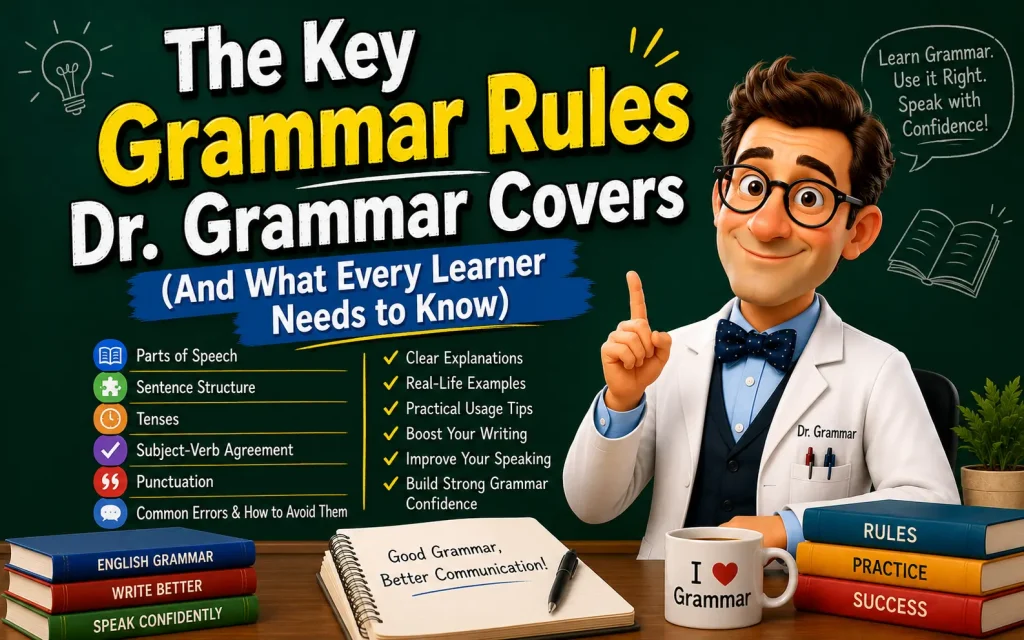
This is where most competitors stop short. They describe the programme but rarely explain the actual grammar content in a way that helps learners. Here is a practical breakdown of the core grammar concepts Dr. Grammar addresses, with clear examples anyone can use today.
1. Subject-Verb Agreement
This is one of the most common grammar errors in English, and one of the most important to fix.
The rule: A singular subject takes a singular verb. A plural subject takes a plural verb.
Examples:
- Correct: “The dog runs fast.”
- Incorrect: “The dog run fast.”
- Correct: “The children play outside.”
- Incorrect: “The children plays outside.”
Where it gets tricky: When a phrase comes between the subject and the verb, many writers lose track.
- Correct: “The list of items is on the table.” (Subject is “list,” not “items.”)
- Incorrect: “The list of items are on the table.”
2. Verb Tenses
English has 12 tenses, but most everyday communication relies on six. Knowing these six well gets you most of the way there.
| Tense | Use | Example |
|---|---|---|
| Simple Present | Habits and facts | “She writes every day.” |
| Present Continuous | Happening right now | “She is writing a letter.” |
| Simple Past | Finished actions | “She wrote the report.” |
| Past Continuous | Ongoing past action | “She was writing when I called.” |
| Simple Future | Plans and predictions | “She will write tomorrow.” |
| Present Perfect | Past with present relevance | “She has written three chapters.” |
Common mistake: Mixing tenses within a single paragraph. Pick a tense and stay consistent unless the timeline genuinely changes.
3. Articles: A, An, and The
Articles cause problems for learners of almost every background.
- Use a before consonant sounds: “a boat,” “a grammar rule.”
- Use an before vowel sounds: “an exercise,” “an hour” (note: “h” is silent here).
- Use the when referring to something specific or already known: “Pass me the pen” (both speaker and listener know which pen).
When to use no article: With plural nouns used in a general sense. “Dogs are loyal” not “The dogs are loyal” (unless referring to specific dogs).
4. Countable and Uncountable Nouns
This is a concept the Dr. Grammar programme introduces early, and for good reason.
Countable nouns have singular and plural forms: book/books, idea/ideas. Uncountable nouns have no plural form: water, advice, information, furniture.
Common mistakes:
- Incorrect: “Can you give me some advices?”
- Correct: “Can you give me some advice?”
- Incorrect: “I have many luggages.”
- Correct: “I have a lot of luggage.”
5. Prepositions of Time and Place
These small words cause outsized confusion.
Time prepositions:
- At for precise times: “at 3 pm,” “at noon”
- On for days and dates: “on Monday,” “on 5 July”
- In for months, years, seasons: “in July,” “in 2025,” “in summer”
Place prepositions:
- At for a specific point: “at the bus stop”
- On for a surface: “on the table”
- In for enclosed spaces: “in the classroom,” “in the box”
6. Pronouns and Antecedents
A pronoun must clearly refer to the noun it replaces.
- Unclear: “Tom told James that he had made a mistake.” (Who made the mistake?)
- Clear: “Tom told James, ‘You made a mistake.'”
Pronoun-antecedent agreement:
- Singular noun, singular pronoun: “Each student should bring his or her book.”
- Plural noun, plural pronoun: “All students should bring their books.”
7. Punctuation Basics
Punctuation guides the reader. Without it, even correct words create confusion.
- The comma: Separate items in a list (“apples, bananas, and oranges”), and use it after introductory phrases (“After school, she went home”).
- The apostrophe: Mark possession (“the teacher’s pen”) or contractions (“it’s” = “it is”). Note: “its” without an apostrophe is possessive; “it’s” with an apostrophe is always “it is.”
- The full stop: End every complete sentence. A sentence fragment is not a complete sentence.
- The colon: Introduce a list or explanation. “She needed three things: a pencil, a ruler, and an eraser.”
What Makes Dr. Grammar Different from Other Grammar Programmes
Most grammar programmes hand students a textbook and ask them to memorise rules. Dr. Grammar takes a different approach.
Here is what sets it apart:
- Stories first, rules second. Grammar rules are introduced through narrative, making them easier to remember and apply.
- Active learning. Students do not just read. They listen, respond, create, and communicate.
- Age-appropriate content. The materials are designed for young learners, not adapted from adult textbooks.
- Curriculum alignment. The programme connects to official language education goals, so teachers can integrate it without disrupting their existing plans.
- Bilingual accessibility. The associated app reaches learners across language backgrounds, particularly English and Spanish speakers.
- Institutional credibility. SCOLAR backing gives the programme verified educational standing. It is not a commercial product pretending to be educational. It is an officially supported learning initiative.
Common Grammar Mistakes Dr. Grammar Helps Fix
Here are ten errors that appear constantly in student writing, along with the Dr. Grammar-style corrections.
- “Their going to the park Should be: They’re going to the park.
- “He don’t know the answer.” Should be: “He doesn’t know the answer.”
- “I should of called.” Should be: “I should have called.”
- “Less students attended.” Should be: “Fewer students attended.” (Use “fewer” for countable things.)
- “Between you and I.” Should be: “Between you and me.”
- “The data is unclear.” Should be: “The data are unclear.” (Data is plural.)
- “Everyday I wake up early.” Should be: “Every day I wake up early.” (“Everyday” is an adjective.)
- “Who did you give it to?” Acceptable in casual speech, but formal: “To whom did you give it?”
- “It’s a criteria.” Should be: “It’s a criterion.” (Criteria is already plural.)
How to Use Dr. Grammar Effectively: Practical Tips
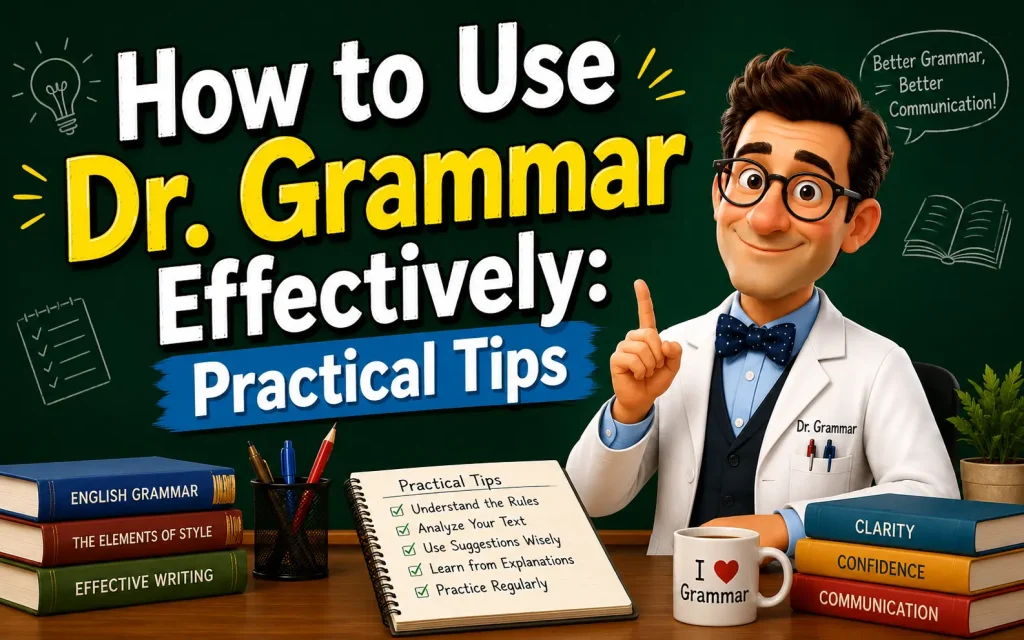
Whether you are a teacher using the school programme or a learner using the app, these strategies will help you get more out of every session.
For Teachers and Educators
- Connect grammar to stories your students already love. Use the “My Boat Can Float” narrative as a model. Find stories in your classroom library and build grammar activities around them.
- Focus on one rule per lesson. Trying to teach five grammar concepts at once leads to confusion. Go deep on one before moving on.
- Use error correction as a teaching tool, not a punishment. When students make mistakes, treat them as learning opportunities. Ask: “Can anyone spot what to change here?”
- Create speaking opportunities. Grammar is not just for writing. Ask students to build sentences aloud before writing them down.
For Individual Learners
- Practice in short daily sessions. Twenty minutes of focused practice every day beats two hours once a week.
- Keep a grammar journal. Write down rules you find confusing, with your own examples. Reviewing your journal regularly cements the learning.
- Read aloud. Reading English text aloud helps your ear pick up natural grammar patterns.
- Use the Dr. Grammar app on your commute. Short mobile sessions add up quickly. Five minutes twice a day is ten minutes of practice you would not otherwise have.
- Write, then edit. Draft your writing without worrying about grammar. Then go back and look specifically for the errors you know you make most often.
Dr. Grammar and the Science of Language Learning
There is strong research behind the approach Dr. Grammar takes.
Comprehensible input (Stephen Krashen, 1982) suggests that learners acquire language most effectively when they encounter it in context they can mostly understand, with just enough challenge to stretch them. Stories like “My Boat Can Float” provide exactly that: familiar language in an engaging, just-challenging-enough context.
Spaced repetition shows that revisiting material at increasing intervals produces stronger long-term memory. The app format supports this naturally because learners return to exercises over multiple sessions.
Active recall beats passive re-reading every time. The exercises in both the school programme and the app make learners retrieve and apply grammar rules, which strengthens memory far more effectively than reading an explanation once.
These are not theories. They are backed by decades of classroom and laboratory research, and Dr. Grammar’s methods line up with them.
Frequently Asked Questions
What age group is Dr. Grammar designed for?
The SCOLAR school programme targets Primary 1 and Primary 2 students (ages 6 to 8). The iOS app suits learners of all ages who want structured grammar practice, particularly those bridging English and Spanish.
Is Dr. Grammar free?
The school programme is funded through SCOLAR and provided to participating Hong Kong primary schools at no cost to families. The iOS app has a free version with optional premium features.
Can adults use Dr. Grammar?
Yes. While the school programme targets young learners, the grammar rules it covers are fundamental for speakers of all ages. The app is suitable for adult learners as well.
What grammar topics does Dr. Grammar cover?
Core topics include subject-verb agreement, verb tenses, articles, countable and uncountable nouns, prepositions, pronouns, and punctuation. The school programme introduces these through story and activity rather than direct instruction.
How is Dr. Grammar different from Grammarly or QuillBot?
Grammarly and QuillBot are correction tools. They fix errors after you make them. Dr. Grammar teaches you why errors happen so you make fewer of them in the first place. The two types of tools complement each other well.
How long does the programme last?
The school programme runs within the academic year, following a structured lesson plan aligned to the curriculum. App-based learning is self-paced and ongoing.
Final Thoughts
Dr. Grammar has become a recognized name for those seeking clear, practical, and easy-to-understand grammar guidance. Whether helping students strengthen their language skills or assisting professionals in improving their writing, Dr. Grammar emphasizes that effective communication begins with a solid understanding of grammar.
Through simple explanations, useful examples, and a learner-friendly approach, the platform has made grammar more accessible to people of all skill levels.
As the importance of strong writing continues to grow in education, business, and digital communication, Dr. Grammar remains a valuable resource for anyone looking to write with greater confidence and accuracy.
By focusing on clarity, consistency, and continuous learning, Dr. Grammar encourages users to build lasting language skills that can benefit them in both their academic and professional lives.
