
Proper grammar is not about sounding fancy. It is about being understood. A single misplaced comma or a confused “your” and “you’re” can change the meaning of a sentence, or make a reader stop trusting what you wrote.
This guide breaks down proper grammar into plain, practical rules you can actually remember and use, whether you are writing an email, a college essay, or a business report.
Unlike most grammar tool pages, which rush you toward a sign-up button, this guide focuses on teaching you the rules themselves: the ones people search for, get wrong, and rarely find explained clearly in one place.
What “Proper Grammar” Actually Means

Grammar is the set of rules that governs how words combine into sentences. Proper grammar means your sentences follow those rules consistently: correct word order, subject-verb agreement, accurate punctuation, and the right word choice for the right context.
It covers four main areas:
- Syntax: how words are ordered to form a sentence.
- Morphology: how words change form (plurals, tenses, possessives).
- Punctuation: the marks that organize meaning, like commas and periods.
- Usage: choosing the correct word among easily confused options.
Mastering these four areas covers almost every grammar mistake you will ever make.
Why Proper Grammar Still Matters
Some people argue grammar rules are outdated in a world of texting and emojis. They are wrong, and here is why:
- Clarity: Grammar removes ambiguity. “Let’s eat, Grandma” and “Let’s eat Grandma” mean very different things.
- Credibility: Readers judge competence based on writing quality, often within seconds. A resume, email, or proposal full of errors signals carelessness, even if the ideas are strong.
- Speed of understanding: Correct grammar lets readers process information faster, because they are not forced to re-read confusing sentences.
- Professional growth: Studies on workplace communication consistently link clear writing to better collaboration and fewer costly misunderstandings.
The Core Grammar Rules Everyone Should Know
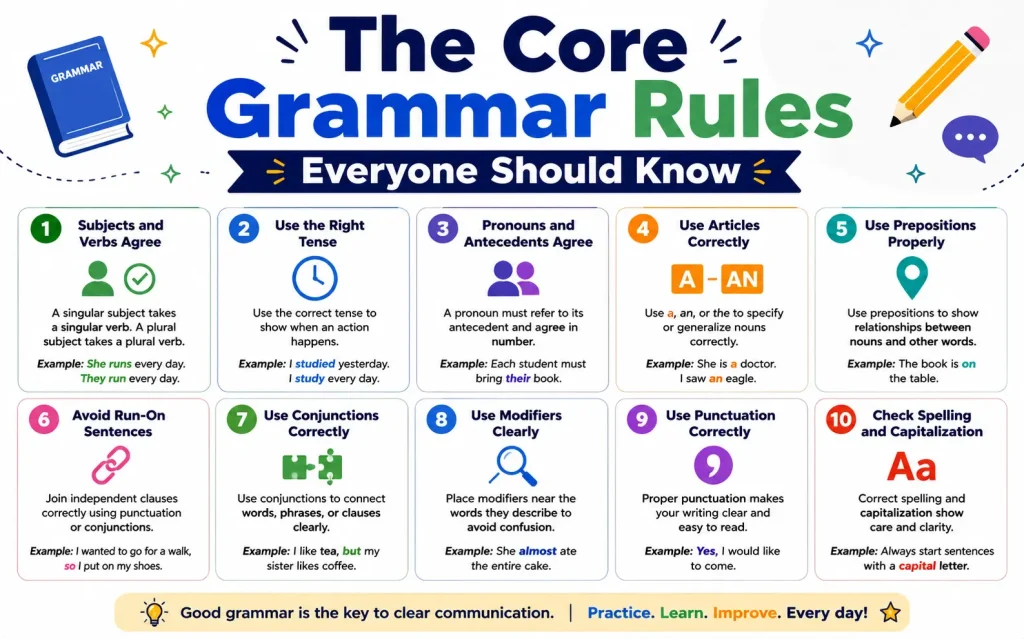
1. Subject-Verb Agreement
The subject and verb in a sentence must match in number.
- Correct: The dog runs every morning.
- Incorrect: The dog run every morning.
This gets tricky with collective nouns and compound subjects:
- The team is winning (team acts as one unit).
- Neither the manager nor the employees were informed (the verb agrees with the noun closest to it).
2. Proper Use of Tenses
Tense tells the reader when an action happens. Mixing tenses mid-sentence confuses your timeline.
- Correct: She finished her report and submitted it.
- Incorrect: She finished her report and submits it.
Stick to one tense unless you are deliberately shifting timeframes, and signal that shift clearly with words like “later” or “before that.”
3. Punctuation That Changes Meaning
Punctuation is not decoration. It controls pacing and meaning.
- Comma: Separates ideas and items. “I invited my parents, Lady Gaga and Humpty Dumpty” reads very differently from “I invited my parents, Lady Gaga, and Humpty Dumpty.”
- Apostrophe: Shows possession or contraction, never plurality. “The cat’s toy” is correct; “The cat’s are sleeping” is not.
- Semicolon: Joins two related, complete sentences without a conjunction. “I have a deadline tomorrow; I am staying late tonight.”
4. Commonly Confused Words
These word pairs cause more grammar complaints than almost anything else:
| Word Pair | Quick Rule | Example |
|---|---|---|
| Your / You’re | “Your” shows possession; “you’re” means “you are” | You’re late for your meeting. |
| Its / It’s | “Its” shows possession; “it’s” means “it is” | The dog wagged its tail. It’s a good dog. |
| Affect / Effect | “Affect” is usually a verb; “effect” is usually a noun | The weather affected the event’s effect on attendance. |
| Then / Than | “Then” relates to time; “than” compares | We ate, then left. She is taller than him. |
| Fewer / Less | Use “fewer” for countable items, “less” for uncountable amounts | Fewer apples, less juice. |
5. Active vs. Passive Voice
Active voice puts the subject in charge of the action, which usually reads as clearer and more direct.
- Active: The committee approved the budget.
- Passive: The budget was approved by the committee.
Passive voice is not wrong, and it has its place when the doer of the action is unknown or unimportant (“The window was broken”). But overusing it makes writing feel vague and distant. Default to active voice for most everyday writing.
6. Avoiding Run-On Sentences and Fragments
A run-on sentence crams two complete thoughts together without proper punctuation:
- Run-on: I went to the store I bought milk.
- Fixed: I went to the store, and I bought milk.
- Or: I went to the store. I bought milk.
A fragment is an incomplete sentence missing a subject, verb, or complete thought:
- Fragment: Because it was raining.
- Fixed: We stayed inside because it was raining.
Grammar Mistakes Most Guides Skip
Most grammar pages stop at the basics above. Here are mistakes that quietly damage writing but rarely get explained well:
- Dangling modifiers: “Walking into the room, the smell hit me” implies the smell was walking.
- Correct version: “Walking into the room, I noticed the smell.”
- Misused apostrophes in decades: Write “1990s,” not “1990’s,” unless you mean something belonging to 1990.
- Overusing intensifiers: Words like “very” and “really” weaken writing rather than strengthen it. Choose a stronger word instead: “exhausted” rather than “very tired.”
- Inconsistent parallel structure: “She likes hiking, swimming, and to read” breaks parallelism.
- Correct: “She likes hiking, swimming, and reading.”
- Confusing “who” and “whom”: Use “who” for the subject of a sentence and “whom” for the object.
- Quick test: if you can replace it with “he,” use “who”; if “him,” use “whom.”
A Simple Self-Editing Checklist

Before you send or publish anything, run through this short list:
- Read the sentence aloud. If you stumble, it likely needs rewording.
- Check that every subject matches its verb in number.
- Confirm tense consistency throughout each paragraph.
- Scan for commonly confused words (your/you’re, its/it’s, then/than).
- Look for run-ons and fragments by checking each sentence has one complete idea.
- Cut unnecessary passive voice where the subject is doing the action.
- Read the piece backward, sentence by sentence, to catch errors your brain skips when reading forward.
How to Improve Your Grammar Over Time
Grammar checkers catch errors, but they do not build long-term skill on their own. To actually get better:
- Read widely and actively. Notice sentence structure in well-edited books, news articles, and essays.
- Keep a personal error log. Write down mistakes you repeat, since most writers have only five or six recurring weak spots.
- Practice rewriting your own sentences in both active and passive voice to understand the difference instinctically.
- Learn one rule a week instead of trying to memorize an entire grammar book at once.
- Use a checker as a second opinion, not a crutch. Understand why a suggestion was made before accepting it, so you stop repeating the same error.
Frequently Asked Questions (FAQs)
What are the most common grammar mistakes?
Common grammar mistakes include confusing their, there, and they’re, your and you’re, its and it’s, incorrect verb tenses, misplaced punctuation, and subject-verb agreement errors.
Does proper grammar help with SEO?
Yes. Proper grammar improves readability, increases user trust, and enhances the overall quality of your content. While grammar is not a direct ranking factor, well-written content can improve user engagement and SEO performance.
Can grammar mistakes affect professional writing?
Yes. Grammar mistakes can make your writing appear unprofessional, reduce credibility, and create misunderstandings in emails, reports, blogs, and other professional documents.
What is the difference between grammar and spelling?
Grammar focuses on the correct structure and use of language, while spelling refers to writing words with the correct sequence of letters. Both are essential for effective communication.
Which tools can help check proper grammar?
Popular grammar-checking tools include Grammarly, Microsoft Editor, LanguageTool, and the built-in grammar checkers available in many word processors.
Final Thoughts
Proper grammar is a skill, not a talent some people are simply born with. It is built rule by rule, mistake by mistake, until correct sentence structure becomes automatic start with the fundamentals in this guide.
Keep a short list of your personal trouble spots, and revisit them often. Clear, correct writing is one of the most practical skills you can develop, and it pays off in every email, essay, and conversation you have.
