

Upload Article SEO Every day, millions of articles and blogs are published online. Most of them never get read because they never rank on Google. The difference between an article that sits on page 10 and one that earns traffic on page 1 is almost always the same thing proper SEO.
Upload Article SEO refers to the full process of writing, structuring, and optimizing articles and blogs before and after you upload them so that search engines understand them, trust them, and rank them. It is not about tricking Google. It is about creating content that is genuinely useful and technically sound.
This guide covers everything that most other tools and articles leave out. You will learn how to plan your article or blog with search intent in mind, how to structure it for both readers and search engines, how to optimize every on-page element, and how to build authority over time. No fluff, no filler.
Section 1: Understanding Upload Article SEO from the Ground Up
What Is UploadArticle SEO
UploadArticle SEO is the practice of preparing, writing, and publishing articles in a way that maximizes their visibility in search engine results pages.
It combines:
- Keyword research and search intent analysis
- On-page content optimization
- Technical SEO elements such as meta tags, URL structure, and schema markup
- Content quality signals such as depth, readability, and E-E-A-T (Experience, Expertise, Authoritativeness, Trustworthiness)
- Post-upload actions such as internal linking, indexing requests, and performance monitoring
Most tools focus on only one or two of these areas. A truly optimized article addresses all of them together.
How Google Evaluates Uploaded Articles
When Googlebot crawls your uploaded article, it evaluates several factors simultaneously:
| Factor | What Google Checks | Impact Level |
| Relevance | Does the content match the search query | Very High |
| Content Quality | Is the content original, accurate, and thorough | Very High |
| E-E-A-T Signals | Who wrote it Are they credible | High |
| Page Experience | Speed, mobile-friendliness, Core Web Vitals | High |
| On-Page SEO | Title tag, meta description, headings, keyword use | High |
| Backlinks | Do authoritative sites link to this article | Medium-High |
| User Signals | Click-through rate, dwell time, bounce rate | Medium |
Section 2: Keyword Research Before You Write a Single Word
Start with Search Intent, Not Just Keywords
The biggest mistake writers make is targeting a keyword without understanding why someone searches for it.
Google groups search intent into four categories:
| Intent Type | What the User Wants | Best Content Format |
| Informational | Learn something new | How-to guides, explainer articles |
| Navigational | Find a specific site or page | Brand/landing pages |
| Commercial | Compare options before buying | Reviews, comparisons, listicles |
| Transactional | Complete a purchase or action | Product pages, sign-up pages |
Before uploading any article, confirm which intent your target keyword carries by looking at the top 10 results on Google. If all the top results are how-to guides, write a how-to guide. If they are comparison articles, write a comparison article. Mismatching your format with search intent is one of the most common reasons articles fail to rank.
How to Find the Right Keywords
Effective keyword research for UploadArticle SEO involves finding terms that are relevant, achievable, and commercially valuable.
Follow this process:
- Start with a seed keyword related to your topic.
- Use tools like Google Search Console, Ahrefs, Semrush, or Ubersuggest to expand your list.
- Filter for keywords with a monthly search volume between 100 and 10,000 (depending on your site authority).
- Prioritize keywords with low to medium keyword difficulty if your site is newer.
- Identify long-tail variations of your main keyword to include naturally throughout your article.
For UploadArticle SEO specifically, also look for related questions using Google’s People Also Ask box and Answer the Public. These questions make excellent subheadings and FAQ entries.
Semantic Keywords and LSI Terms
Google no longer ranks content based only on exact keyword repetition. It understands topics semantically. This means your article should include related terms, synonyms, and contextually relevant phrases that signal topical depth.
For example, an article about UploadArticle SEO should naturally include terms such as: article optimization, on-page SEO, keyword placement, meta tags, content structure, readability score, internal linking, and SERP ranking. These terms should appear organically in your writing, not forced into the text.
Section 3: Writing the Article for Both Readers and Search Engines
The Ideal Article Structure for SEO
A well-structured article signals clarity and authority to both readers and crawlers.
Every article you upload should follow this structure:
| Article Section | Purpose | SEO Function |
| Title (H1) | Capture attention and state the topic | Primary keyword placement |
| Introduction | Hook reader and establish relevance | Keyword in first 100 words |
| Section Headings (H2) | Organize main topics | Secondary keyword placement |
| Subheadings (H3) | Break down complex ideas | Long-tail keyword targeting |
| Body Paragraphs | Deliver detailed, accurate information | Topical depth and E-E-A-T |
| Lists and Tables | Improve scannability | Featured snippet eligibility |
| FAQ Section | Answer common questions | People Also Ask targeting |
| Conclusion + CTA | Summarize and guide next action | User engagement signal |
Writing for Readability
Google’s ranking systems have become increasingly sophisticated at measuring whether users actually find content helpful. High bounce rates and low dwell times are indirect signals that your content is not meeting user expectations.
Apply these readability principles when writing your article:
- Keep sentences under 20 words whenever possible.
- Avoid passive voice. Write in active voice throughout.
- Use short paragraphs of 2 to 4 sentences maximum.
- Define technical terms the first time you use them.
- Use transition words to connect ideas smoothly (for example, however, therefore, in addition).
- Aim for a Flesch Reading Ease score of 60 or above for most audiences.
Keyword Placement Rules
Where you place your target keyword matters as much as how often you use it.
Follow these keyword placement best practices:
| Placement Location | Recommendation |
| Title tag (H1) | Include exact keyword, ideally near the beginning |
| First 100 words | Use the keyword naturally in the opening paragraph |
| At least one H2 heading | Use the keyword or a close variation |
| Meta title | Include the exact keyword within 60 characters |
| Meta description | Use the keyword early, within 155 characters |
| URL slug | Short, keyword-focused, no stop words |
| Image alt text | Describe the image and include keyword where relevant |
| Body text | Use keyword and LSI terms naturally; aim for 1-2% density |
Section 4: On-Page SEO Optimization Checklist
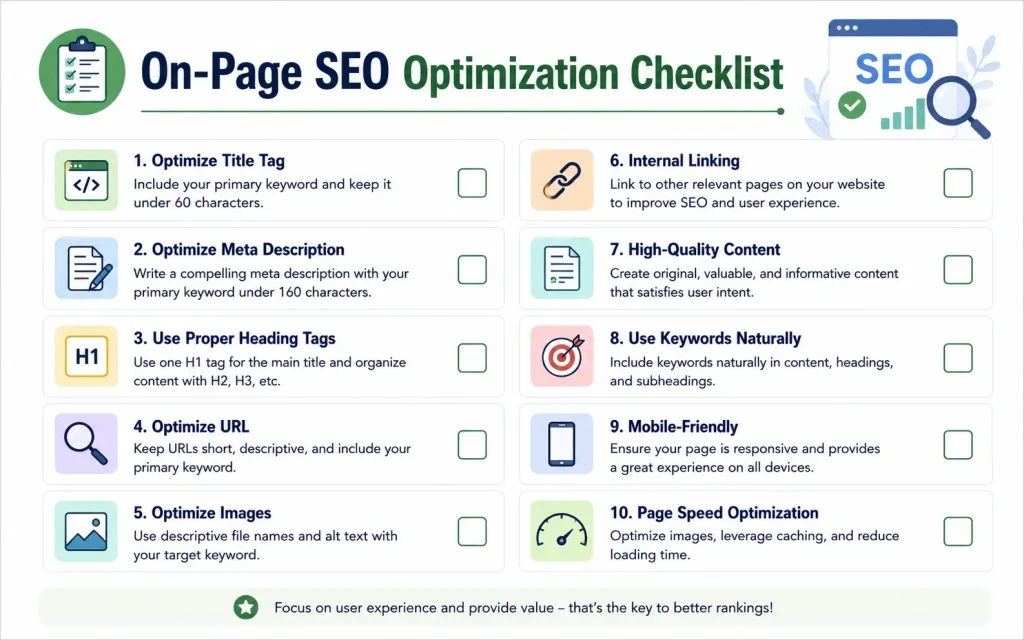
On-page SEO refers to all the optimizations you make within the article and its page settings before publishing. This is what most people call the technical side of content SEO.
Title Tag Optimization
- Keep the title tag under 60 characters.
- Place the primary keyword as close to the beginning as possible.
- Make the title specific and compelling to improve click-through rates.
- Avoid duplicate title tags across your site.
Meta Description Optimization
- Write a unique meta description for every article.
- Keep it between 140 and 155 characters.
- Include the primary keyword naturally.
- Use active voice and include a call to action such as ‘Learn how’, ‘Discover’, or ‘Find out’.
- Treat the meta description as a mini-advertisement for your article.
URL Slug Best Practices
- Keep URLs short and descriptive.
- Use hyphens to separate words, not underscores.
- Include the primary keyword in the URL.
- Remove stop words such as ‘a’, ‘the’, ‘of’, ‘and’.
- Never change a URL after the article has been indexed without setting a 301 redirect.
Image Optimization
- Compress images before uploading to reduce page load time.
- Use descriptive file names that include the keyword (e.g., uploadarticle-seo-guide.jpg).
- Write descriptive alt text for every image.
- Use next-generation image formats such as WebP where possible.
- Add captions to images where relevant to add context for crawlers.
Schema Markup for Articles
Schema markup is structured data that you add to your article’s HTML to help Google understand the content’s context.
For articles, the most commonly used schema types are:
- Article schema: Provides metadata about the article including headline, author, and publication date.
- FAQPage schema: Makes your FAQ section eligible to appear in rich results.
- BreadcrumbList schema: Helps Google understand your site’s navigation structure.
- HowTo schema: Applicable if your article explains a process with clear steps.
Competitors rarely explain schema markup in the context of article uploads. Adding it correctly is one of the fastest ways to improve how your content appears in search results.
Section 5: Content Quality and E-E-A-T Standards
Google’s Search Quality Evaluator Guidelines place heavy emphasis on E-E-A-T: Experience, Expertise, Authoritativeness, and Trustworthiness. These are not just content principles. They directly influence how Google’s ranking systems assess the quality of your article.
How to Demonstrate E-E-A-T in Every Article
| E-E-A-T Component | How to Show It in Your Article |
| Experience | Include first-hand insights, case studies, or real examples from practice |
| Expertise | Cite credible data, statistics, and reference authoritative sources |
| Authoritativeness | Link to and from high-authority sites; build a consistent publishing record |
| Trustworthiness | Be accurate, transparent about limitations, and update content regularly |
Content Depth: The 10x Content Principle
Your article does not just need to be good. It needs to be significantly better than what already ranks.
This means:
- Covering the topic more completely than competitors.
- Answering questions that competitors leave unanswered.
- Including original data, insights, or perspectives that cannot be found elsewhere.
- Updating the content regularly to reflect current information.
- Including multiple content formats: text, tables, numbered lists, and practical examples.
Avoiding Content That Hurts Rankings
Certain content patterns actively harm your ability to rank. Avoid these at all costs:
- Keyword stuffing: repeating the keyword unnaturally to inflate density.
- Thin content: articles under 600 words with little informational value.
- Duplicate content: publishing content that already exists verbatim elsewhere.
- Outdated information: leaving incorrect or obsolete facts in published articles.
- Over-optimization: using the exact keyword in every heading and paragraph.
Section 6: Technical SEO Factors That Affect Article Ranking
Page Speed and Core Web Vitals
Even a perfectly written article will not rank if the page it lives on loads slowly. Google uses Core Web Vitals as a ranking signal.
The three key metrics are:
| Core Web Vital | What It Measures | Target Score |
| Largest Contentful Paint (LCP) | How fast the main content loads | Under 2.5 seconds |
| Interaction to Next Paint (INP) | How quickly the page responds to user input | Under 200 milliseconds |
| Cumulative Layout Shift (CLS) | How stable the page layout is during loading | Under 0.1 |
To improve these metrics: use a fast web host, enable browser caching, minimize JavaScript, compress images, and use a content delivery network (CDN).
Mobile Optimization
Google uses mobile-first indexing, meaning it primarily uses the mobile version of your content to rank it.
Every article you upload must:
- Render correctly on screens as small as 360 pixels wide.
- Use a responsive design that adjusts to all screen sizes.
- Have tap targets large enough for mobile users.
- Avoid intrusive pop-ups that block content on mobile devices.
HTTPS and Site Security
Google confirmed HTTPS as a ranking signal. Ensure your site uses a valid SSL certificate. An article published on an HTTP site will rank lower than an identical article on a secure HTTPS domain.
Crawlability and Indexability
Before Google can rank your article, it must be able to crawl and index it. Check the following:
- Your robots.txt file does not block the article URL.
- The article page does not have a ‘noindex’ meta tag unless intentional.
- Your sitemap.xml includes the article URL.
- There are no orphan pages: the article is linked from at least one other page on your site.
After uploading a new article, submit it for indexing using Google Search Console. Go to URL Inspection, enter your article URL, and click ‘Request Indexing’. This tells Google to crawl the page sooner rather than waiting for the next scheduled crawl.
Section 7: Internal Linking and Site Architecture
Internal linking is one of the most underused SEO tactics in article optimization. When you link from one article to another on your site, you pass authority, help Google understand your content structure, and guide readers to more content.
Internal Linking Best Practices
- Link to related articles naturally within the body text.
- Use descriptive anchor text that includes relevant keywords.
- Link from older, authoritative articles to new ones to help new content get indexed faster.
- Do not use generic anchor text like ‘click here’ or ‘read more’.
- Aim for at least 3 to 5 internal links in every article over 1,000 words.
Pillar and Cluster Content Strategy
A highly effective way to structure your articles for SEO is to use the pillar-cluster model:
- Pillar page: A comprehensive, long-form article that covers a broad topic in depth.
- Cluster pages: Individual articles that cover specific subtopics related to the pillar page.
- Internal links : connect all cluster pages back to the pillar and to each other.
This structure tells Google that your site has strong topical authority on a given subject, which helps all articles in the cluster rank higher over time.
Section 8: Post-Upload SEO Actions
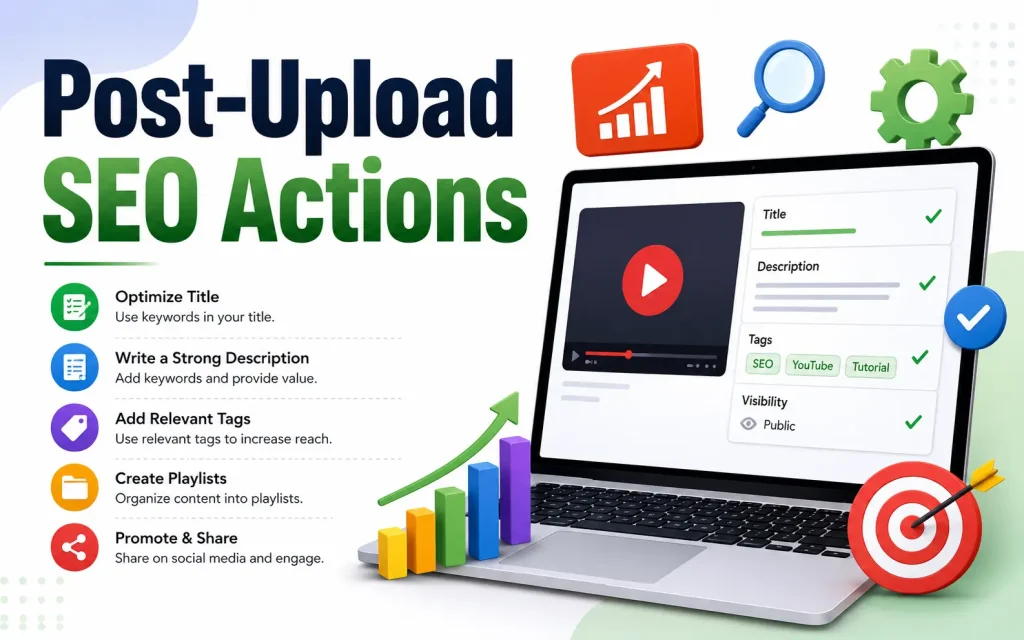
Most guides stop at publishing. The actions you take immediately after uploading an article are just as important as what you did before.
Step-by-Step Post-Upload Checklist
- Submit the URL to Google Search Console using the URL Inspection tool.
- Share the article on relevant social media channels to generate initial traffic signals.
- Build at least 2 to 3 internal links from existing articles to the new one.
- Monitor the article’s position in Google Search Console within 7 to 14 days.
- Check for crawl errors or indexing issues in the Coverage report.
- Identify which keywords the article is ranking for and optimize further if needed.
- Update the article within 90 days if performance data shows it is underperforming.
Tracking Article Performance
Use these tools to monitor how your article is performing after upload:
| Tool | What to Track |
| Google Search Console | Impressions, clicks, average position, CTR for each keyword |
| Google Analytics 4 | Sessions, bounce rate, engagement time, traffic source |
| Ahrefs or Semrush | Keyword ranking changes, backlinks earned, competitor comparison |
| PageSpeed Insights | Core Web Vitals performance of the article page |
When and How to Update Articles
Google favors fresh, accurate content.
If an article has been live for more than 6 months and is not ranking in the top 20, consider these updates:
- Add new statistics or data that were not available when you first published.
- Expand thin sections with more detail and examples.
- Add or improve internal links and update any broken external links.
- Refresh the introduction and conclusion to feel current.
- Update the publication date if the changes are substantive.
UploadArticle SEO vs. General Article Publishing: Key Differences
| Aspect | Standard Article Publishing | UploadArticle SEO |
| Keyword Research | Optional or minimal | Required before writing begins |
| Content Structure | Author’s preference | Based on search intent and SERP analysis |
| Meta Tags | Often skipped | Optimized title and description for every article |
| Image Optimization | Basic upload | Compressed, named, and alt-tagged |
| Internal Links | Rarely added | Minimum 3-5 per article |
| Schema Markup | Not used | Added for article, FAQ, or HowTo as relevant |
| Post-Upload Actions | None | Indexing request, performance monitoring, updates |
| E-E-A-T Focus | Incidental | Deliberate and structured |
FAQs
What is Upload Article SEO?
Upload Article SEO is the process of optimizing content before and after publishing to improve visibility in search engines.
Why is SEO important when publishing articles?
SEO helps search engines understand your content and increases the chances of ranking higher in search results.
Should I add images to my articles?
Yes. Optimized images with alt text improve user experience and support SEO.
How do I get Google to index my article faster?
You can submit your article URL through Google Search Console for faster indexing.
How often should I publish SEO articles?
Consistency matters more than quantity. Publishing high-quality articles regularly can improve long-term rankings.
Final Thought
UploadArticle SEO is not a one-time checklist. It is a discipline that combines strategic thinking, quality writing, technical awareness, and ongoing performance management. The writers and publishers who consistently rank on Google are not lucky. They are systematic.
Every article you upload is an opportunity to build your site’s authority, attract targeted readers, and generate long-term organic traffic. By applying the principles in this guide, from intent-driven keyword research to post-upload monitoring, you give every article the best possible chance of ranking, getting read, and driving real results.
Start with one article. Apply every step in this guide. Track the results. Then repeat and refine. That is how UploadArticle SEO works in practice.
You May Also Like It:
SEO Agency in Australia Upload Article
